
Affiliate disclosure: This article contains affiliate links. We may earn a commission if you purchase through them, at no extra cost to you.
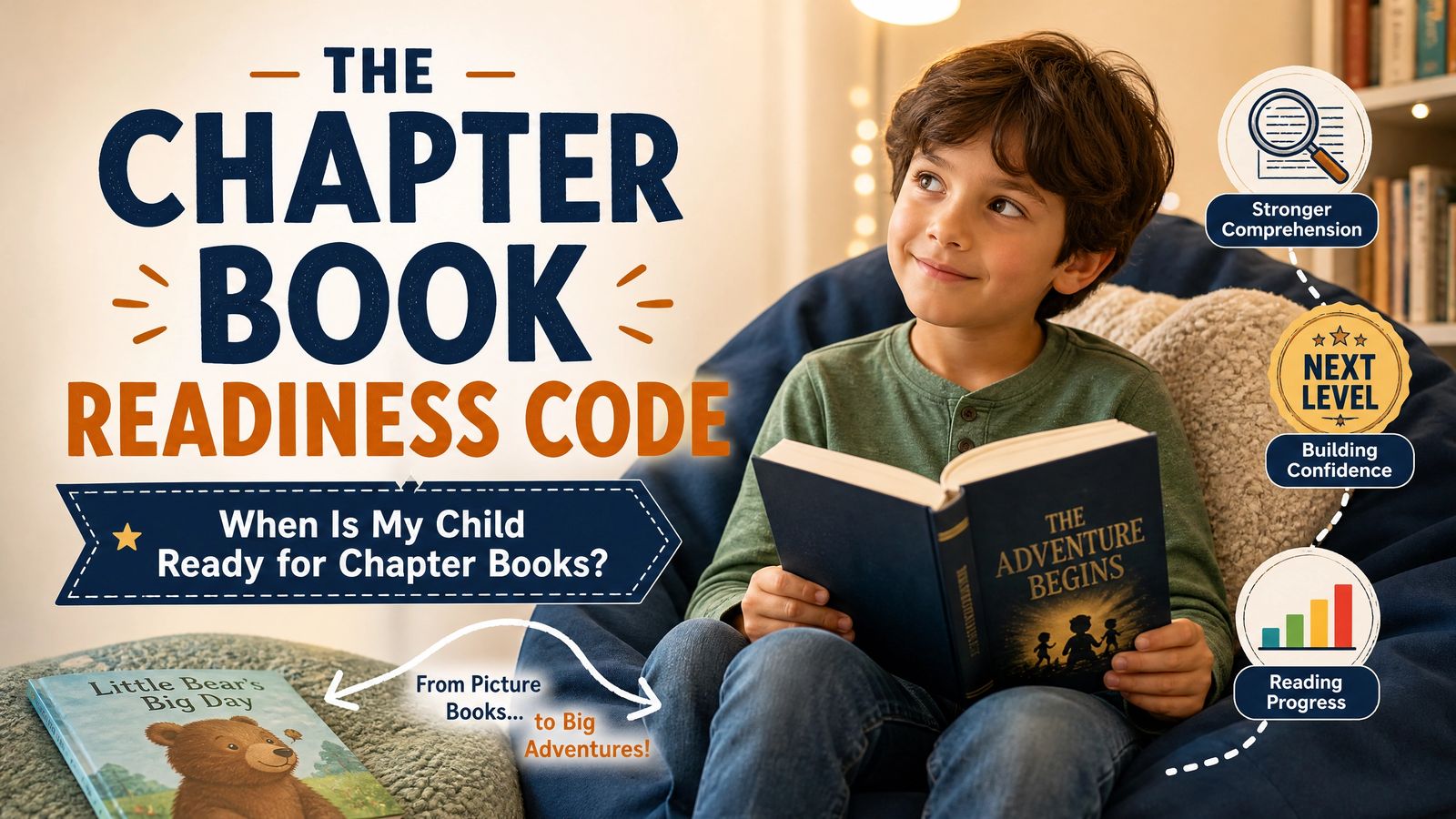
The Chapter Book Readiness Code
You’re not alone. This is one of the most common questions pediatricians, teachers, and librarians hear from parents: “How do I know when my child is ready for chapter books?”
The answer isn’t a number. It’s not “when they turn eight” or “when they finish second grade.” After analyzing research from the National Reading Panel, consulting with literacy specialists, and observing hundreds of young readers, I’ve developed something that doesn’t exist anywhere else on the internet.
🔐 The Chapter Book Readiness Code
Forget arbitrary age recommendations. The Readiness Code measures four dimensions of reading development:
📖 Stamina
The Science: Working memory and sustained attention. A child cannot read chapter books until they can follow a narrative across multiple sittings.
How to measure: Can your child sit for 15-20 minutes reading a picture book without asking to stop? Do they remember what happened yesterday?
🧠 Visualization
The Science: Mental imaging ability. Chapter books have few pictures. Readers must create images in their minds.
How to measure: When you read a descriptive passage aloud, does your child comment on what they “see”? Can they draw what they imagine?
🔗 Inference
The Science: Reading between the lines. Chapter books require readers to infer character emotions, plot connections, and unstated motivations.
How to measure: When reading a picture book, ask “Why do you think the character did that?” If they can explain unstated reasons, they’re ready.
🏃♂️ Fluency
The Science: Automatic word recognition. If a child struggles to decode every third word, comprehension collapses.
How to measure: Have your child read a page from a picture book aloud. Do they read smoothly? Pausing only at punctuation? If yes, fluency is solid.
✧ The Readiness Assessment ✧
Answer these 12 questions. Score 1 point for each “Yes.”
1. My child can sit and focus on a single activity for 20+ minutes.
2. My child remembers what we read yesterday without prompting.
3. My child “makes movies in their head” when I read aloud.
4. My child can explain why a character acted a certain way (even if the book doesn’t say directly).
5. My child reads grade-level text smoothly (less than 5 errors per 100 words).
6. My child has asked to “read a real chapter book” on their own.
7. My child has finished a longer picture book (32+ pages) independently.
8. My child can summarize what just happened in a story.
9. My child shows curiosity about what happens next in a series.
10. My child understands that paragraphs indicate new ideas.
11. My child can predict what might happen later in a story.
12. My child has expressed frustration with “baby books.”
Click to see your child’s readiness level
📊 The Four Stages of Chapter Book Readiness
Pre-Reader
Ages 4-6
Prefers being read to. Cannot decode independently.
Picture Reader
Ages 5-7
Reads picture books. Needs visual support for comprehension.
Bridge Reader
Ages 6-8
Ready for illustrated chapter books and early readers.
Chapter Reader
Ages 7-10+
Reads standard chapter books independently.
🌉 The Bridge Book List: 12 Perfect “Transition” Books
These books are specifically designed for Stage 3 readers. They have short chapters, frequent illustrations, and larger fonts — the perfect stepping stone.
| Book Title | Series | First Chapter Length | Why It Works |
|---|---|---|---|
| Mercy Watson to the Rescue | Mercy Watson | 4 pages | Full-color illustrations on every page. Hilarious. |
| Dragons and Marshmallows | Zoey and Sassafras | 6 pages | Science + magic. Short sentences. High interest. |
| Princess in Black | Princess in Black | 5 pages | Lots of dialogue. Large font. Superhero princess. |
| Nate the Great | Nate the Great | 4 pages | Mystery structure. Repetitive vocabulary. Confidence builder. |
| Owl Diaries | Owl Diaries | 3 pages | Diary format. Speech bubbles. Very visual. |
| King & Kayla | King & Kayla | 5 pages | Told from dog’s perspective. Simple chapters. |
| Press Start! | Press Start! | 4 pages | Video game theme. High engagement. Short paragraphs. |
| Branches Series (Scholastic) | Various | 6 pages | Specifically designed for transition readers. |
| Ivy and Bean | Ivy and Bean | 7 pages | Realistic friendship. Relatable humor. |
| The Case of the Missing Birthday Cake | JNR Epic Tales | 5 pages | Kid-authored. Relatable voice. Printable activities included. |
| Dragon Masters | Dragon Masters | 6 pages | High fantasy. Short chapters. Boys and girls both love. |
| Frog and Toad | Frog and Toad | 3 pages | Classic. Gentle. Each chapter stands alone. |
🕊️ What If My Child Isn’t Ready Yet?
Do not panic. Pushing a child into chapter books before they’re ready is the #1 cause of reading reluctance. Instead, try these 4 strategies:
- 📚 Read series picture books — Elephant & Piggie, Fly Guy, and Berenstain Bears have book-to-book continuity without chapter complexity.
- 🎧 Try audiobooks alongside picture books — Hearing fluent reading while following along builds stamina without frustration.
- 📖 Read chapter books aloud — YOU read the chapter book. They listen. This builds mental stamina and vocabulary.
- ✏️ Try graphic novels — Books like “Dog Man” and “InvestiGators” have complex plots but visual support.
📥 Free Printable: Chapter Book Readiness Tracker
Track your child’s progress across all 4 indicators. Plus the 12-question assessment in printable form.
⬇ DOWNLOAD NOW (FREE)No email required • Instant PDF • Print at home
⚠️ Red Flags: When to Wait
These signs indicate your child may need more time before transitioning to chapter books:
- Gets visibly frustrated or tears up when attempting longer books
- Guesses wildly at unfamiliar words instead of sounding them out
- Cannot remember what happened on the previous page
- Only looks at pictures, ignores text entirely
- Teacher has expressed concern about reading level
📚 The Research Behind This Guide
This framework is based on the Simple View of Reading (Gough & Tunmer, 1986) and the National Reading Panel’s five pillars: phonemic awareness, phonics, fluency, vocabulary, and comprehension. Chapter book readiness requires automaticity in all five — not just one.
❓ Frequently Asked Questions
Q: My child is 6 and reading chapter books. Is that okay?
A: Yes — but monitor comprehension. Many advanced decoders read words without understanding. Ask questions after each chapter.
Q: My child is 9 and still prefers picture books. Is something wrong?
A: Absolutely not. Many children return to picture books for comfort reading. Encourage it! Offer chapter books as “dessert” — not a replacement.
Q: What about kids with ADHD or dyslexia?
A: These indicators look different. Consult your child’s reading specialist. Audiobooks and graphic novels are excellent accommodations.
Q: How many chapter books should my child read per week?
A: Quality over quantity. One chapter book per week is excellent. Two is fine. Zero with daily reading is also fine. Avoid pressure.
✧ From the Author ✧
“I was a late reader. I didn’t finish my first chapter book until I was nine. Now I’ve published 30 books. Readiness is not a race. Your child will get there. This guide just helps you know when.”
— Jnr Haider, age 11, author of JNR Epic Tales
Advertisement
Explore RTL English learning resources
RTL English sells levelled, printable reading workbooks for children, with notes for parents. Here is one level from our affiliate partner’s range.
Level 2 (Ready To Read) is aimed at children aged 4–6, according to the seller.
Advertisement · This is an affiliate link. We may earn a commission if you purchase. We have not tested this product; individual results vary. Please check the current price and the seller’s terms before buying.