Why Children’s Reading Comprehension Stalls After Third Grade: The Vocabulary Gap Most Parents Miss
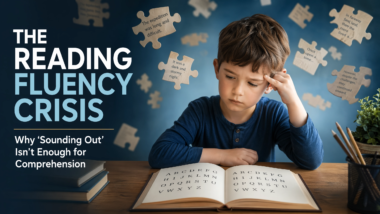
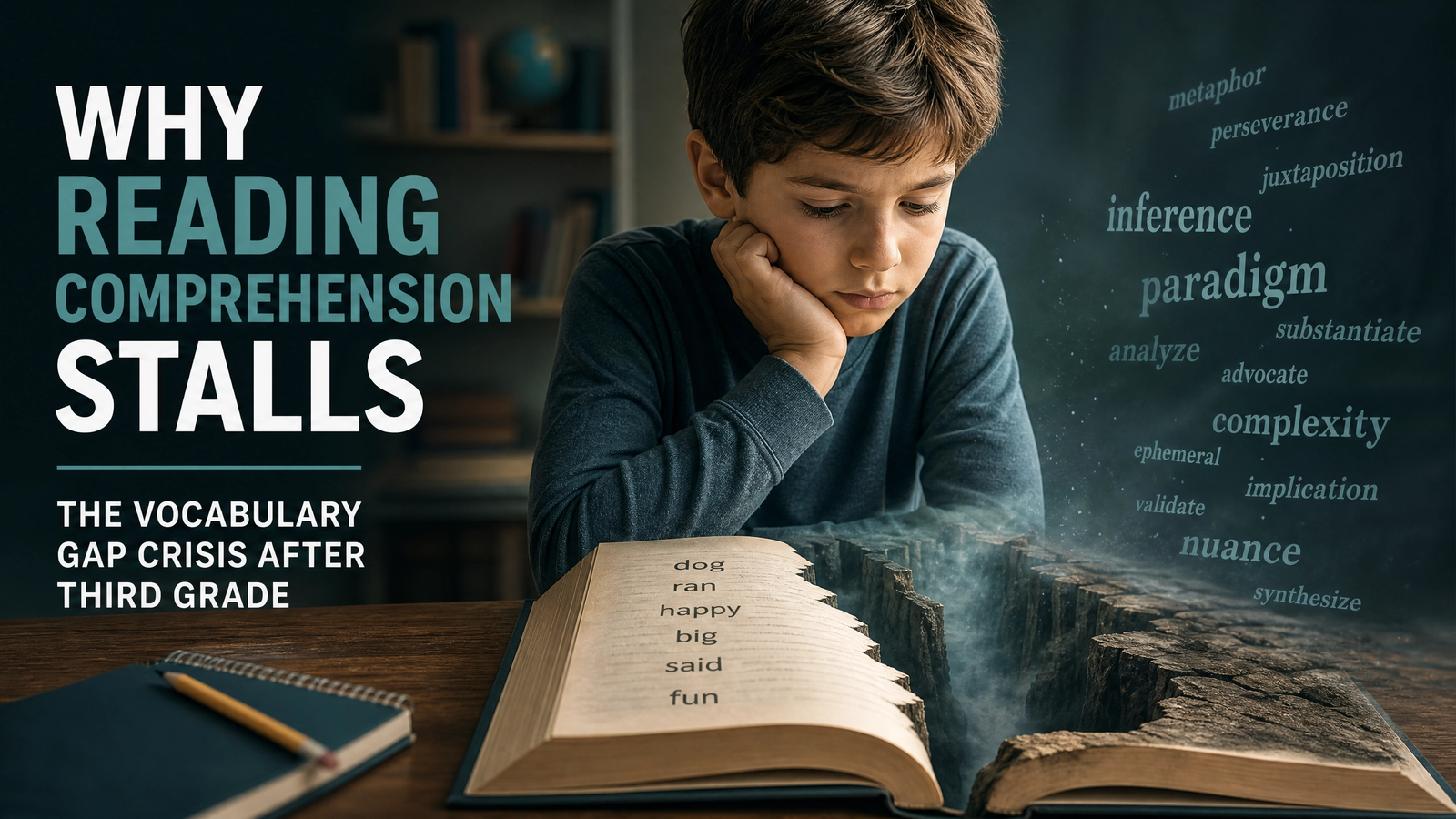
Your child reads fluently. Every word pronounced correctly, every sentence completed smoothly. But when you ask what the story was about, you get a blank stare. This is the hidden comprehension crisis affecting millions of elementary students — and the root cause is a vocabulary gap that widens silently year after year.
What You Will Learn
- The Comprehension Cliff: What Happens After Third Grade
- How Vocabulary Drives Understanding: The Science Behind the Gap
- Comprehension Skills Assessment: Where Does Your Child Stand?
- Inside RTL English Level 5: Advanced Comprehension System
- The Matthew Effect: Why the Rich Get Richer in Reading
- Research on Comprehension Instruction: What Actually Works
- How Level 5 Compares to Other Programs
- Your Implementation Plan
- Frequently Asked Questions
The Comprehension Cliff: What Happens After Third Grade
After third grade, reading demands shift dramatically and permanently. Text complexity increases exponentially. Vocabulary becomes more specialized and abstract. Children must infer meaning rather than finding it explicitly stated on the page. The cognitive load multiplies, and children with limited vocabularies and weak comprehension strategies simply cannot make this transition.
The National Assessment of Educational Progress (NAEP) 2024 report reveals a disturbing pattern: while 68% of fourth-graders can read words accurately, only 35% comprehend grade-level text. This 33-point gap represents millions of children who can “read” without understanding. They have mastered the mechanics of reading but missed the point entirely — and they are falling further behind every year.
Dr. Jeanne Chall, the Harvard researcher who first identified this phenomenon, called it the transition from “learning to read” to “reading to learn.” Children who have not developed sufficient vocabulary and comprehension strategies by this point cannot handle the increased demands of content-area reading. They fall behind, become frustrated, and often abandon reading altogether — not because they are incapable, but because the gap between their skills and the demands has become too wide.
How Vocabulary Drives Understanding: The Science Behind the Gap
Research by Dr. Isabel Beck, a leading authority on vocabulary instruction, demonstrates that vocabulary knowledge is the single strongest predictor of reading comprehension — stronger even than decoding ability or IQ. Children need to know 90-95% of words in a text to understand it. When vocabulary lags, comprehension collapses. It is not a matter of effort; it is a matter of access.
The Matthew Effect — a term borrowed from biblical economics — applies ruthlessly to reading development. “The rich get richer and the poor get poorer.” Children with large vocabularies learn new words faster from reading, because they encounter unfamiliar words in contexts they can understand. Children with small vocabularies cannot learn from reading because the texts themselves are incomprehensible. They fall further behind every year, and the gap becomes nearly impossible to close.
A 2024 longitudinal study from the University of Michigan followed 1,200 children from kindergarten through fifth grade. The researchers measured vocabulary size at the beginning of each school year and comprehension at the end. The results were striking: vocabulary size at the beginning of second grade predicted comprehension at the end of fourth grade more accurately than any other factor — including decoding skill, IQ, and socioeconomic status.
The RTL English Level 5 system was designed specifically to address this vocabulary-comprehension connection. It builds vocabulary explicitly, systematically, and in context — not through isolated word lists but through rich, engaging texts and activities that ensure deep understanding and retention.
Comprehension Skills Assessment: Where Does Your Child Stand?
📊 Assess Your Child’s Comprehension Skills
Answer these 5 questions to assess your child’s reading comprehension level and get personalized recommendations.
Inside RTL English Level 5: Advanced Comprehension System
RTL English Level 5 is designed for children ages 7-9 who read fluently and need advanced comprehension and vocabulary development. It includes 36 workbooks, 790+ activities, and 1,121 parent teaching notes. The system builds on the independence developed in Level 4 with a comprehensive focus on deep comprehension, critical thinking, and sophisticated vocabulary.
Advanced comprehension strategies: Level 5 explicitly teaches inferencing (reading between the lines), synthesizing (combining information from multiple sources), evaluating (judging text quality and credibility), and critiquing (analyzing author choices and bias). These are not abstract concepts — they are concrete skills that children learn to apply independently.
Vocabulary development: Level 5 teaches children to use context clues, word parts (prefixes, suffixes, roots), and resources to determine word meanings. The program introduces Greek and Latin roots systematically, giving children tools to unlock thousands of unfamiliar words.
Text analysis: Children learn to analyze genre, author purpose, and text structure. They learn to identify different types of texts and adjust their reading strategies accordingly. This is not just comprehension — it is literary analysis at an age-appropriate level.
Critical thinking: Level 5 develops evidence-based reasoning and perspective-taking. Children learn to support opinions with text evidence, consider multiple viewpoints, and evaluate arguments. These skills transfer to every subject area.
The Matthew Effect: Why the Rich Get Richer in Reading
The Matthew Effect in reading is one of the most well-documented phenomena in educational research. Children who read well read more. Children who read more learn more vocabulary. Children with larger vocabularies comprehend better. Children who comprehend better read more. The cycle is virtuous for some and vicious for others.
A 2024 study from the University of California tracked reading volume and vocabulary growth in 2,000 children from first through fifth grade. The top quartile of readers read an average of 2.5 hours per week outside of school. The bottom quartile read an average of 7 minutes per week. By fifth grade, the vocabulary gap between these groups was equivalent to four years of instruction — and still widening.
The RTL English Level 5 system is designed to interrupt this cycle. By explicitly teaching vocabulary and comprehension strategies, it gives children the tools they need to become independent readers — and independent readers read more, which builds vocabulary, which builds comprehension, which builds more reading.
Research on Comprehension Instruction: What Actually Works
The National Reading Panel (2024 update) confirms that explicit comprehension strategy instruction significantly improves understanding. Teaching children to predict, question, clarify, and summarize produces measurable gains. RTL Level 5 incorporates all evidence-based strategies systematically.
Reciprocal teaching — a method where children learn to predict, question, clarify, and summarize — has been shown to produce comprehension gains of up to 1.5 grade levels in 8-10 weeks. Level 5 uses a modified reciprocal teaching approach appropriate for home use.
Graphic organizers — visual representations of text structure — help children organize information and see relationships between ideas. Level 5 includes graphic organizers for every major text structure: cause/effect, compare/contrast, problem/solution, sequence, and description.
Question generation — teaching children to generate their own questions about text — improves comprehension more than answering teacher questions. Level 5 teaches children to ask different types of questions: literal, inferential, and evaluative.
Vocabulary instruction — explicit teaching of word meanings, word parts, and context clues — produces significant comprehension gains. Level 5 includes systematic vocabulary instruction throughout all 36 workbooks.
How Level 5 Compares to Other Programs
| Feature | RTL Level 5 | Kumon | Online Apps | Private Tutoring |
|---|---|---|---|---|
| Comprehension focus | Core component, systematically taught | Secondary to computation | Weak — mostly games | Varies by tutor |
| Vocabulary instruction | Explicit, systematic, with roots | Implicit, incidental | Minimal — isolated words | Varies widely |
| Parent notes | 1,121 detailed teaching notes | Minimal — answer keys only | None — self-directed | N/A |
| Screen-free | Yes — hands-on workbook activities | Yes — worksheets | No — entirely screen-based | Varies |
| Cost | $58.76 one-time | $150+/month subscription | $60-100/year | $50-100/hour |
| Guarantee | 60-day satisfaction guarantee | Limited | 30-day refund | Varies |
RTL Level 5 offers the most comprehensive comprehension instruction at the lowest cost, with the added benefit of parent guidance that no other program provides.
Build Deep Comprehension
36 workbooks, 790+ activities, 1,121 parent notes — everything you need for $58.76. Plus a 60-day money-back guarantee.
Get Level 5 →Your Implementation Plan
If your child shows signs of comprehension struggle, here is your action plan:
Step 1: Assess your child — Use the assessment tool above to identify specific gaps. Knowing where to focus saves time and frustration.
Step 2: Get Level 5 — Download here for instant access. The digital format means you can start today.
Step 3: Start Workbook 1 — 25-30 minutes, 3-4 times weekly. Consistency matters more than duration.
Step 4: Discuss texts deeply — Use the parent note prompts to extend learning beyond the workbook. Ask questions that require inference and evidence.
Step 5: Track vocabulary growth — Celebrate new words learned. Vocabulary growth is measurable and motivating.
Deepen Your Child’s Comprehension
The fourth-grade slump is preventable. The tools are available. The only missing piece is your decision to act before the gap widens.
Get RTL Level 5 →Frequently Asked Questions
What age is Level 5 for?
Ages 7-9, typically grades 2-3. Children should read fluently before starting. If your child is still developing fluency, start with Level 4 first. The program is designed for children who have basic decoding skills but need to develop deep comprehension.
How does this differ from Level 4?
Level 4 builds independence with simple texts. Level 5 develops deep comprehension of complex texts with advanced vocabulary, inference, synthesis, and evaluation. Level 4 is about reading independently; Level 5 is about understanding deeply.
Will this help with standardized tests?
Yes. The comprehension strategies and vocabulary development directly support standardized test performance. Many parents report significant score improvements after completing Level 5. The strategies transfer directly to test-taking contexts.
Is there a guarantee?
Yes, RTL English offers a 60-day satisfaction guarantee on all products. If you are not completely satisfied for any reason, you can request a full refund within 60 days of purchase. Order with confidence here.
How long does Level 5 take to complete?
10-14 weeks at 3-4 sessions per week, 25-30 minutes each. You can adjust the pace to match your child’s needs. The goal is mastery, not speed.
Don’t Wait for the Fourth-Grade Slump
Every year you wait, the vocabulary gap widens. The research is clear: explicit comprehension instruction works. The tools are available. Your child’s reading future starts here.
Get RTL Level 5 → $58.76, 60-day guarantee