
Affiliate disclosure: This article contains affiliate links, including links to RTL English. If you buy through them we may earn a commission, at no extra cost to you.
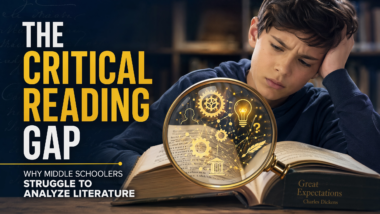
Many children aged 8–10 read fluently and can retell a story well, but have not yet learned to ask why an author made a choice. Critical reading is a teachable skill. This guide explains what it involves and how you can build it at home with everyday books.
In this guide
From retelling to thinking: what changes at 8–10
Early reading instruction focuses on decoding words and understanding what happened. As children get older, schoolwork increasingly asks them to go further: to infer what a character feels, to identify a theme, to compare two texts and to back up an opinion with evidence from the text. Reading researchers often describe this as a shift from “learning to read” to “reading to learn”, a framing associated with Jeanne Chall’s stages of reading development.
A child who is a “surface reader” is not a weak reader. They simply have not yet been shown the questions that skilled readers ask themselves. The good news is that these questions can be modelled, practised and gradually handed over to the child.
The four skills behind critical reading
1. Inference
Inference means combining clues in the text with what the reader already knows to work out something the author has not stated directly. Asking “How do you know?” after your child makes a guess is one of the simplest ways to practise it.
2. Theme
Theme is the bigger idea a story explores, such as friendship, fairness or courage. Children often confuse theme with plot. A helpful prompt is: “What do you think the author wants us to understand about people or life?”
3. Character motivation and change
Ask why a character acted as they did and whether they changed by the end. Comparing a character at the beginning and end of a book is a concrete way to discuss growth.
4. Author’s choices
Why did the author start the story here, choose this word, or tell it from this point of view? These questions help children see texts as deliberately constructed, which also supports their own writing.
Questions to ask after reading
You do not need special materials to start. Pick one or two questions per session rather than all of them:
- What do you think will happen next, and what in the story makes you think so?
- Why do you think the character did that? Is there another possible reason?
- Did your opinion of a character change? When?
- What is this story really about, beyond what happens?
- Why might the author have ended the story this way?
- Whose point of view is missing?
A simple critical-reading checklist
Critical-reading skills checklist (ages 8–10)
Tick the skills you have noticed in conversation over the last few weeks.
0 of 7 ticked
The checklist is a conversation aid, not a test. Children develop at different rates, and a skill that is “not yet” today often appears within a few months of regular practice.
Using a structured programme
Some families prefer a structured, printable programme so they do not have to plan every session. Whatever you choose, look for clear guidance for parents, short regular sessions, a mix of fiction and non-fiction, and activities that ask children to explain their thinking rather than just tick answers.
Affiliate resource
About RTL English Level 6 (Proficient Reader, ages 8–10)
According to the seller, Level 6 is a digital home learning pack of 36 printable workbooks with 2,943 exercises, 782 activities and 1,081 notes for parents, designed for children aged 8–10. We have not tested it ourselves, and individual results vary.
See RTL English Level 6 on the seller’s site →
Prices, sales and refund terms change. Check the current price and the seller’s guarantee terms before buying. This is an affiliate link: we may earn a commission if you buy, at no extra cost to you.
Frequently asked questions
At what age should children start analysing stories?
Children can discuss characters and feelings from a very young age. More formal analysis, such as identifying themes and citing evidence, typically becomes a focus in the later primary years. Follow your child’s lead and keep it conversational.
My child reads a lot but never thinks about the meaning. Is that a problem?
Enjoying reading is valuable in itself. If you would like to build deeper thinking, add one or two open questions after reading, and share your own reactions. Avoid turning every book into a quiz.
Will critical reading help in other subjects?
Inference, using evidence and comparing viewpoints are used across the curriculum, for example when interpreting sources in history. Practising them in reading gives children a foundation, although transfer to other subjects is not automatic.
What if my child finds it frustrating?
Keep sessions short, use books they choose, and accept partial answers. Praise the reasoning rather than whether the answer matches yours.
Affiliate resource
About RTL English Level 6 (Proficient Reader, ages 8–10)
According to the seller, Level 6 is a digital home learning pack of 36 printable workbooks with 2,943 exercises, 782 activities and 1,081 notes for parents, designed for children aged 8–10. We have not tested it ourselves, and individual results vary.
See RTL English Level 6 on the seller’s site →
Prices, sales and refund terms change. Check the current price and the seller’s guarantee terms before buying. This is an affiliate link: we may earn a commission if you buy, at no extra cost to you.
Sources and further reading
- Improving Reading Comprehension in Kindergarten Through 3rd Grade (IES What Works Clearinghouse practice guide)
- National Reading Panel: Teaching Children to Read (NICHD, 2000)
- The Nation's Report Card: 2024 Reading Assessment (NAEP, grades 4 and 8)
- National Literacy Trust: support for parents and families
Last reviewed October 2026.
Disclosure: This article contains affiliate links to RTL English. If you buy through them, JNR Epic Tales may earn a commission at no extra cost to you. We have not tested RTL English ourselves; product details come from the seller’s website, and individual results vary. This article is general educational information. If you are worried about your child’s reading, speak to their teacher, school or a qualified specialist.