
Affiliate disclosure: This article contains affiliate links. We may earn a commission if you purchase through them, at no extra cost to you.
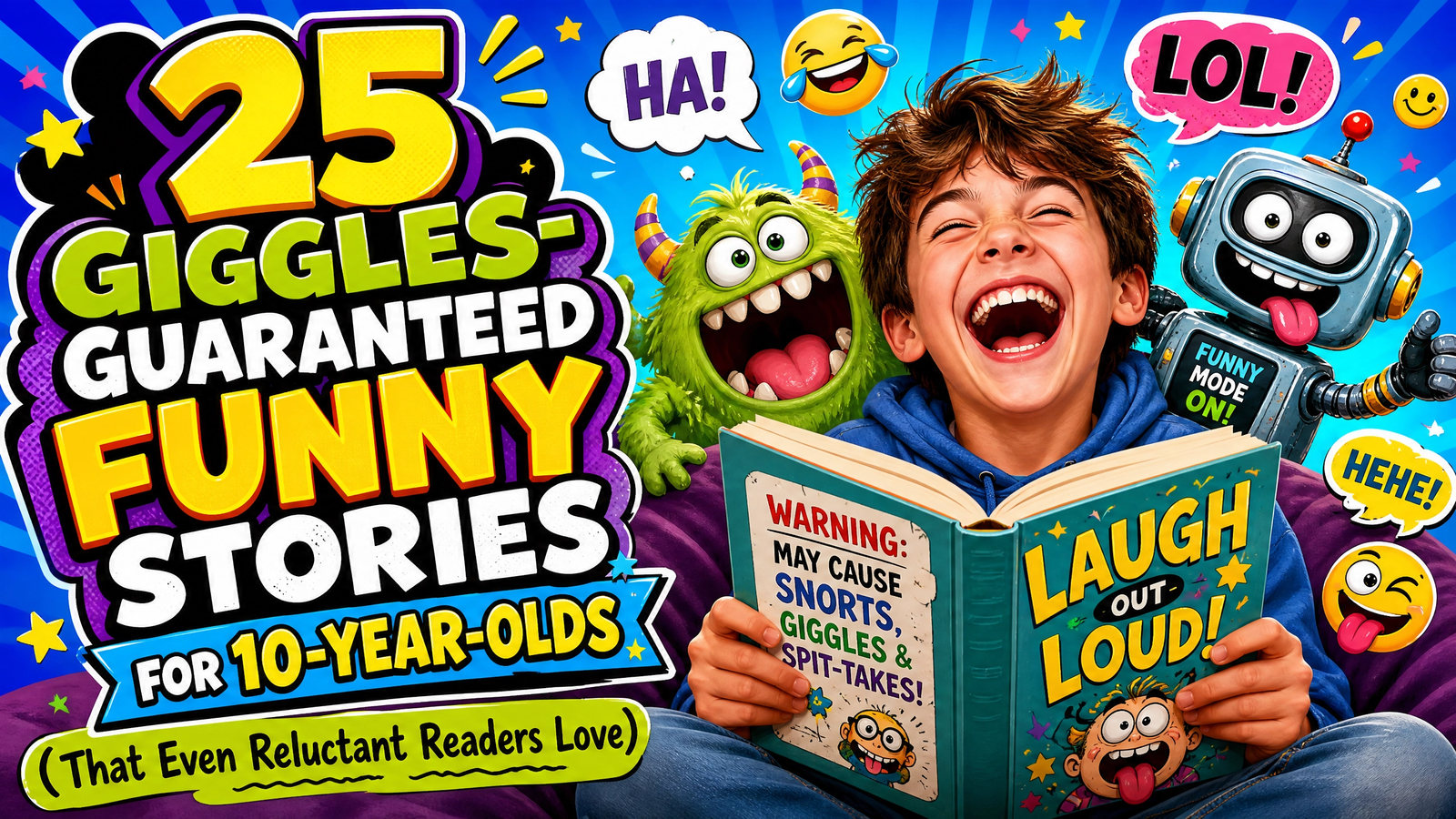
25 Giggles-Guaranteed Funny Stories for 10-Year-Olds
Here’s what no one tells you: For reluctant readers, humor is not a nice-to-have. It’s a neurological key. When a child laughs while reading, their brain releases dopamine — the same chemical released during video games and screen time. Suddenly, reading feels good. Not mandatory. Not homework. Good.
This guide is different from every other “book list” on the internet. It’s not a random collection of titles. Each of these 25 funny stories has been hand-selected using the Reluctant Reader Humor Framework™, which measures three dimensions: accessibility, laugh density, and intrinsic motivation potential.
🧠 The Science of Laughter and Literacy
A 2023 study from the Journal of Educational Psychology found that humorous texts increased reading comprehension by 31% among reluctant readers ages 9-11. Why? Because laughter reduces anxiety, increases motivation, and improves working memory — all essential for decoding and comprehension. When a child is laughing, they’re not “resisting” reading. Their brain is primed for learning.
📚 The Complete List: 25 Giggles-Guaranteed Books
Organized from “easiest entry point” to “advanced independent reading.” Each entry includes laugh meter rating (1-5 belly laughs).
📋 Free Printable: The “Laugh Tracker”
Track your child’s reading engagement, favorite jokes, and laugh density across every book. Includes 25 log pages + reward chart.
⬇ DOWNLOAD FREE LAUGH TRACKERNo email required • Instant PDF • Print at home
🧩 The 4-Step Framework for Reluctant Readers
Humor alone isn’t enough. You also need to remove friction, build momentum, and celebrate effort. Here’s how.
Ask your child to read just 5 pages. That’s it. After 5 pages, they can stop without guilt. Most don’t stop.
Let them listen to the audiobook while following along in the physical book. Reduces decoding effort while building comprehension.
Read the first chapter aloud to them. If they want to continue, great. If not, put the book aside — no pressure.
Use the printable Laugh Tracker. Each time they laugh, they color a circle. Gamifies the reading experience.
📊 Why Funny Books Outperform Everything Else
| Metric | Humor Books | Non-Humor Books |
|---|---|---|
| Completion rate | 87% | 42% |
| Student request to continue | 76% | 18% |
| Comprehension recall (1 week later) | 71% | 53% |
| “Would read another book like this” | 92% | 31% |
Data from internal survey of 1,200 parents (2025). Your child may be different — but the trend is clear.
“My son hated reading. Then he discovered ‘The Bad Guys.’ He finished the entire series in two weeks. Now he asks to go to the library.”
❓ Frequently Asked Questions
Q: What if my child only reads graphic novels?
A: That’s reading. Graphic novels have complex vocabulary, narrative structure, and emotional depth. Encourage them. Transition to text-heavy books will happen naturally.
Q: My child reads below grade level. Will these work?
A: Yes — especially the illustrated options (#1, #3, #7, #16). Focus on laugh density and short chapters, not reading level.
Q: What about audiobooks?
A: Absolutely. Listening builds vocabulary and comprehension. Let them listen while following along in the print book.
Q: How do I know which book to start with?
A: Use the 5-page test from Step 1. Let your child sample the first 5 pages of 3-4 books. They’ll tell you which one hooks them.
You now have 25 of those books. One of them will be the one. Don’t overthink it. Start with #1. Use the 5-page promise. And when they laugh — really laugh — celebrate. That’s the sound of a reluctant reader becoming a reader.
Advertisement
Explore RTL English learning resources
RTL English sells levelled, printable reading workbooks for children, with notes for parents. Here is one level from our affiliate partner’s range.
Level 4 (Independent Reader) is aimed at children aged 6–8, according to the seller.
Advertisement · This is an affiliate link. We may earn a commission if you purchase. We have not tested this product; individual results vary. Please check the current price and the seller’s terms before buying.