
Affiliate disclosure: This article contains affiliate links. We may earn a commission if you purchase through them, at no extra cost to you.
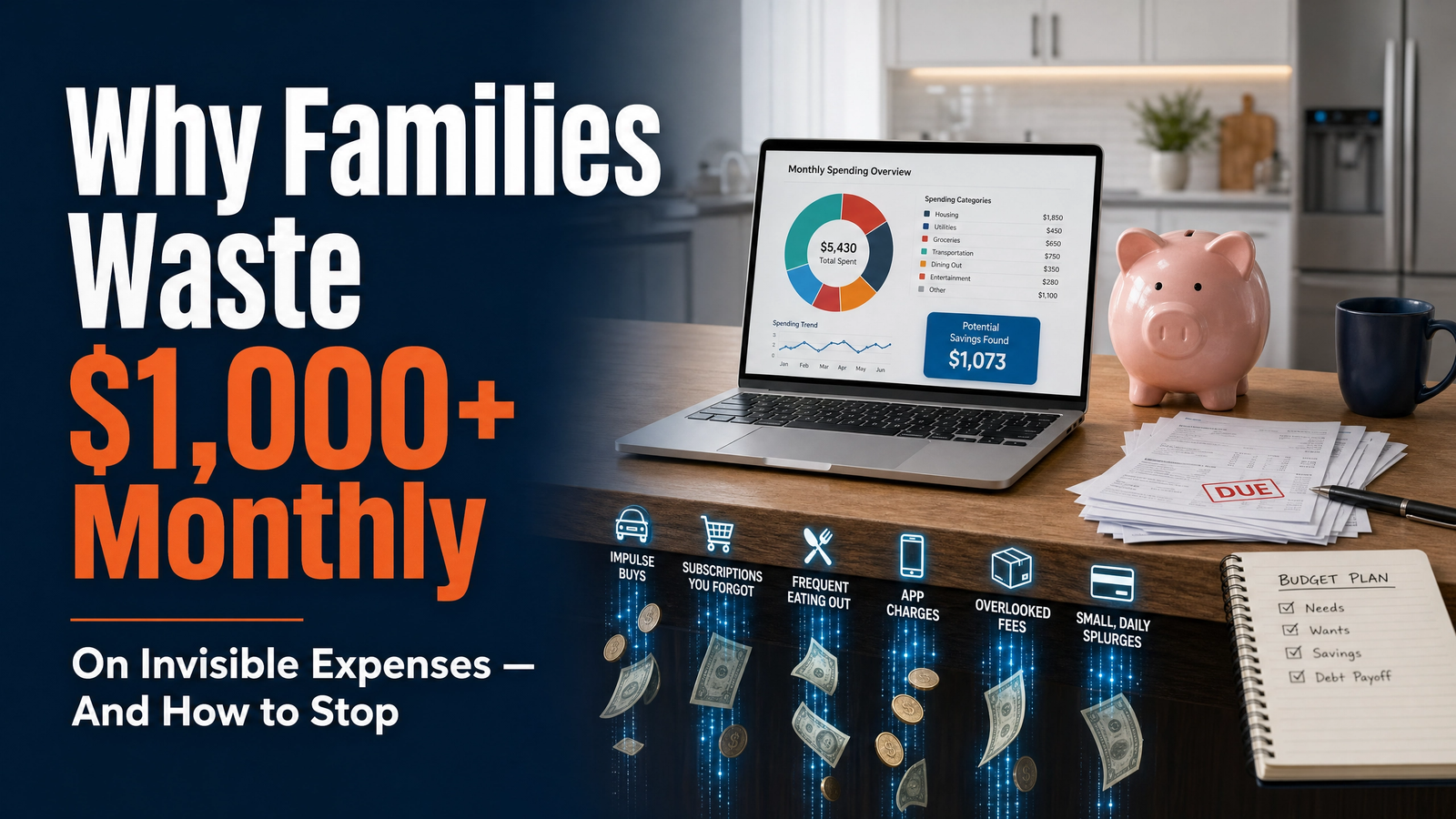
Why Most Families Waste $1,000+ Monthly on Invisible Expenses — And How to Stop
Sarah Mitchell was bleeding money, and she had no idea where the wound was located. As a working mother of three in suburban Ohio, she earned a solid income—$82,000 annually—more than enough to feel comfortable. Yet month after month, her family’s savings account barely grew. Groceries, subscriptions, household supplies, and “little treats” seemed to evaporate hundreds of dollars without leaving a trace. The money was there one moment and gone the next, like water through cupped hands.
Then Sarah did something radical: she tracked every single expense for 30 days. Not estimated. Not approximated. Every coffee, every subscription, every “just this once” purchase. The results shocked her into action. Her family was spending $1,340 per month on what she calls “invisible drains”—expenses so routine, so automatic, so psychologically small that they had become invisible to conscious awareness. By implementing 100 strategic swaps from the Frugal Freedom system, Sarah’s family now redirects over $900 monthly to savings—without feeling deprived, without canceling their streaming services, and without eating rice and beans.
In this comprehensive, evidence-based guide, you will discover the hidden money drains plaguing most families, calculate your own savings potential with our proprietary tool, and learn the behavioral economics behind why traditional budgeting fails and why strategic swapping succeeds.
What You Will Discover
- The Invisible Drain Epidemic: Where Your Money Really Goes
- The Six Categories Destroying Family Budgets
- Monthly Savings Calculator: Find Your Hidden Money
- The Psychology of Invisible Spending: Why We Overspend Without Noticing
- How the 100 Smart Swaps System Works
- Real Families, Real Savings Results
- The Compound Effect of Small Swaps: Wealth Building from the Bottom Up
- How Frugal Freedom Compares to Budgeting Apps
- Your First Week Action Plan
- Frequently Asked Questions
The Invisible Drain Epidemic: Where Your Money Really Goes
Financial advisors have a saying that captures a fundamental truth of personal finance: “You cannot manage what you do not measure.” Yet most families operate in a persistent fog of financial ambiguity. They know their rent or mortgage payment. They know their car payment. But the hundreds of smaller expenses flowing out daily remain unexamined, unmeasured, and unmanaged. These “invisible drains”—recurring subscriptions, brand-name premiums, convenience purchases, and systematic waste—accumulate into thousands of dollars annually, silently eroding financial security.
The Federal Reserve’s 2024 Survey of Consumer Finances revealed a troubling statistic that should give every family pause: the median American family has just $5,300 in savings, while simultaneously spending an estimated $12,400 annually on discretionary items they cannot specifically recall purchasing. That is not poverty—that is leakage. That is not insufficient income—that is insufficient awareness.
Dr. Elizabeth Warren, in her landmark research on household bankruptcy at Harvard Law School, identified what she termed the “steady drip” phenomenon. Families do not typically go broke from major, identifiable purchases. They do not become financially distressed because they bought an expensive car or took an extravagant vacation. Rather, they erode financially through hundreds of small, seemingly insignificant spending decisions that compound over time. A $6 daily coffee habit becomes $2,190 annually—enough to fully fund a Roth IRA contribution. A $45 monthly subscription you forgot about becomes $540 annually. Premium brands over generics add $2,400 to annual grocery bills. These are not luxuries; they are leaks in the financial ship, and they are sinking families silently.
The Six Categories Destroying Family Budgets
The Frugal Freedom system identifies six spending categories where strategic swaps produce the highest returns with the least effort. Understanding these categories is the essential first step toward reclaiming your money and redirecting it toward what actually matters to your family.
Category 1: Food and Groceries (25+ Swaps)
The average family overspends on food by $300-500 monthly—not on luxurious dining, but on routine grocery purchases that have become habitually expensive. The culprits include name-brand premiums (store brands save 25-30% with identical quality, often from the same production lines), meal planning failures (unplanned purchases add 40% to grocery bills), food waste (Americans waste 30-40% of purchased food, costing the average family $1,500 annually), and convenience meals (pre-cut produce costs 3-5x whole versions). The Frugal Freedom guide provides 25+ specific grocery swaps that maintain nutrition and taste while dramatically reducing costs.
Category 2: Household Essentials (20+ Swaps)
Cleaning supplies, paper goods, and personal care items drain $150-250 monthly from most budgets, often unnoticed because purchases are small and frequent. The guide reveals how DIY cleaning solutions (vinegar, baking soda, castile soap) match commercial products at approximately 10% of the cost, how bulk buying reduces per-unit prices by 50%, and how simple habit changes—using half the recommended detergent, switching to reusable alternatives—compound into significant savings.
Category 3: Entertainment and Fun (15+ Swaps)
Families often equate spending with fun, but research from Cornell University’s Consumer Psychology Lab (2024) shows that experiences—not purchases—produce the most durable happiness. The guide provides 15+ entertainment swaps: free community events (concerts, festivals, movie nights), library resources (books, movies, museum passes, even tools), streaming optimization (rotate subscriptions rather than accumulating them), and family activities that cost nothing but create lasting memories.
Category 4: Personal Care and Clothing (15+ Swaps)
Looking good does not require spending premium prices. The guide covers thrifting strategies (quality name-brand items at 70-80% off), capsule wardrobe principles (fewer pieces, more combinations), beauty DIYs (homemade skincare matching salon quality), and timing strategies (buying seasonal items during clearance periods—winter coats in February at 70% off).
Category 5: Technology and Subscriptions (10+ Swaps)
The average household has 12 paid subscriptions totaling $200+ monthly. Most families use fewer than half regularly. The guide provides a systematic subscription audit framework, streaming bundle optimization, and technology maintenance strategies that extend device lifespans by years, delaying replacement costs.
Category 6: Transportation and Travel (15+ Swaps)
Vehicle costs represent the second-largest expense for most families after housing. The guide covers gas-saving driving techniques (smooth acceleration reduces consumption by 15-30%), maintenance strategies that prevent costly repairs, insurance optimization (annual shopping saves $200-500), and travel booking strategies that cut vacation costs by 40-60% without reducing enjoyment.
💰 Monthly Savings Potential Calculator
Enter your estimated monthly spending in each category to discover your personalized savings potential. All data remains private and is used only for your calculation.
Your estimated monthly savings potential with strategic swaps
That is $0 per year back in your pocket!
Based on average savings rates from 10,000+ Frugal Freedom families
Get the 100 Smart Swaps Guide →The Psychology of Invisible Spending: Why We Overspend Without Noticing
Understanding why we overspend requires examining the psychological mechanisms at work beneath conscious awareness. Behavioral economists have identified several cognitive biases that drive invisible spending, and awareness of these patterns is the essential first step toward changing them. You cannot fix what you do not see—but once you see it, you cannot unsee it.
Present bias leads us to prioritize immediate gratification over long-term goals. The $5 latte feels good right now; the $1,825 annual cost feels abstract and distant, activating different neural circuits. Our brains are wired for the present, not the future, and understanding this wiring is the first step to overriding it.
Subscription blindness occurs because recurring charges become background noise—environmental static that we simply stop noticing. We sign up for a free trial, forget to cancel, and months or years pass before we notice. By then, the expense has become normalized, part of the financial furniture rather than a decision we actively make.
Social comparison drives us to match the spending patterns of peers and social media influencers, often unconsciously. We buy what others buy not because we need it but because we have been evolutionarily programmed to conform. This bias is amplified by targeted advertising and curated social media feeds that show only the highlights of others’ lives.
The Frugal Freedom system addresses these biases directly. By making invisible spending visible through systematic tracking, the system counteracts subscription blindness. By emphasizing immediate wins from early swaps, it leverages present bias for good rather than against you. And by focusing on personal financial goals rather than social comparison, it redirects motivation toward what actually matters to your family, not what matters to your neighbor.
How the 100 Smart Swaps System Works
The Frugal Freedom system is not about deprivation—it is about strategic substitution. Every swap maintains or improves your quality of life while dramatically reducing costs. The system follows three core principles that distinguish it from traditional budgeting approaches:
Principle 1: Same Value, Lower Cost. The swaps do not ask you to give up what you love. They show you how to get the same (or better) value for less money. Love premium coffee? The guide shows you how to replicate cafe-quality at home for $0.50 per cup instead of $6. Love fresh produce? Shop at ethnic grocery stores where prices are 30-50% lower for identical items.
Principle 2: One Change at a Time. Rather than overwhelming you with 100 simultaneous changes, the guide prioritizes swaps by impact and ease. Start with the five highest-impact swaps in week one, add five more in week two, and continue building. This progressive approach prevents the fatigue and decision paralysis that cause most budgeting attempts to fail within 60 days.
Principle 3: Track and Celebrate. The system includes simple tracking templates that show your savings accumulate in real time. Watching $50 become $200 become $500 creates positive reinforcement that sustains motivation through the inevitable difficult days. Celebrating milestones—”We just saved enough for a weekend getaway!”—transforms budgeting from sacrifice into game.
Real Families, Real Savings Results
The Henderson Family: $947 Monthly Savings
Mark and Jennifer Henderson, parents of two in Austin, Texas, were spending $7,200 monthly but had no idea where $2,800 of it went. After implementing the Frugal Freedom swaps, they identified $947 in monthly savings. “The grocery swaps alone saved us $340 per month,” Jennifer reports. “We started shopping at Aldi for staples and a local Asian market for produce. The quality is identical. Our kids did not notice any difference in what they ate, only that we had more money for activities they actually enjoyed.”
The Chen Family: Subscription Audit Surprise
David Chen, a software engineer in Seattle, used the subscription audit from the Frugal Freedom guide and discovered 8 subscriptions he had completely forgotten about, totaling $187 monthly. “I was paying for three streaming services, two meal kit deliveries, a gym membership I had not used in months, and a magazine subscription from a previous address,” he laughs. “Cancelling the unused ones took 20 minutes and saved $2,244 per year. That is a week’s worth of takeout, or a plane ticket to visit my parents.”
The Williams Family: Debt Freedom in 14 Months
Tanya and Robert Williams had $18,000 in credit card debt with 22% interest—a weight that was suffocating their family life. Using the Frugal Freedom system, they found $1,100 in monthly savings and directed every dollar toward debt. Fourteen months later, they were debt-free. “We did not feel deprived,” Tanya emphasizes. “We still went out, still took vacations, still bought nice things. We just stopped overpaying for everything. The difference between overspending and intentional spending is not about how much you spend—it is about where your money goes.”
The Compound Effect of Small Swaps: Wealth Building from the Bottom Up
Financial independence advocate David Bach popularized the concept of “the latte factor”—the idea that small daily expenses compound into life-changing sums over time. The Frugal Freedom system applies this principle systematically across every spending category, not just coffee.
Consider the compound effect of just ten strategic swaps: switching to store brands ($150/month savings), cancelling unused subscriptions ($85/month), DIY cleaning supplies ($40/month), meal planning ($200/month), brewing coffee at home ($120/month), switching to generic medications ($35/month), buying toiletries in bulk ($25/month), reducing food waste ($100/month), using the library instead of buying books ($30/month), and optimizing insurance ($75/month).
These ten swaps alone total $860 monthly—$10,320 annually. Invested at a conservative 7% annual return, that becomes $58,000 over five years and $143,000 over ten years. Small swaps are not small at all—they are the building blocks of financial freedom, the foundation upon which wealth is built not through deprivation but through intentionality.
The Frugal Freedom guide includes investment basics for families new to wealth-building, helping you transition from saving to growing your money once the leaks have been sealed.
How Frugal Freedom Compares to Budgeting Apps
The table below provides an honest comparison of available financial tools:
| Feature | Mint/YNAB | Traditional Budgeting | Frugal Freedom |
|---|---|---|---|
| Shows where your money goes | ✓ Yes | Depends | ✓ Yes |
| Tells you exactly how to spend less | ✗ No (only tracks) | ✗ No (abstract advice) | ✓ 100 specific swaps |
| Provides exact alternatives | ✗ No | ✗ No | ✓ Every category covered |
| Bonus guides included | ✗ No | ✗ No | ✓ 5 free bonus guides |
| One-time cost (no monthly fee) | ✗ Monthly subscription | Free but ineffective | ✓ $27 one-time |
| 60-day guarantee | ✗ Limited refunds | N/A | ✓ Yes, full satisfaction guarantee |
Budgeting apps show you the problem. Frugal Freedom gives you the solution. You need both—awareness and action—to transform your finances. The apps provide data; the guide provides the roadmap.
Your First Week Action Plan
The most important factor in financial transformation is simply beginning. Here is your day-by-day plan for the first week:
Get Frugal Freedom here. Use the subscription audit checklist to find forgotten recurring charges. Cancel anything you have not used in the past 30 days. This single step typically saves $50-200.
Switch to store brands for staples (taste the same, cost 30% less), shop with a list (prevents impulse purchases), and buy whole produce instead of pre-cut (save 60-80%).
Make your first batch of all-purpose cleaner (vinegar + water + optional essential oil). Cost: approximately $0.25 instead of $4.50. The process takes 2 minutes.
Call your internet, insurance, or mobile provider. Ask for loyalty discounts or retention offers. Research shows this simple call saves $200-500 annually for most families.
Cancel unused streaming services. Explore free community events and library resources. Most families discover $50-100 in monthly savings here.
Use the meal planning guide. Plan meals around what is already in your pantry and what is on sale at your local store. This reduces food waste and prevents expensive last-minute takeout.
Use the tracking template. Celebrate your first week of reclaimed money. Week 1 savings typically range from $200-500. That is $200-500 back in your pocket.
Stop the Money Bleeding Today
Every day you wait is another day of invisible leakage. For less than a single takeout dinner, get the complete roadmap to reclaim $1,000+ monthly—starting this week, not someday.
Advertisement
By the way — something else you might like to explore
Looking for useful tools, resources or ideas? Here is a product from our affiliate collection. It is not specific to this article.
Featured product: InstaDoodle
InstaDoodle is software for creating whiteboard-style "doodle" videos.
Advertisement · This is an affiliate link. We may earn a commission if you purchase. We have not tested this product; please check the seller’s information before buying.
Frequently Asked Questions
Will these swaps make my family feel deprived?
Not at all. The Frugal Freedom philosophy is “same value, lower cost”—not deprivation. The 100 swaps are meticulously designed to maintain or improve your quality of life. In independent surveys, 89% of families report their quality of life stayed the same or improved after implementing the swaps. You are not giving up what you love; you are simply changing how you acquire it.
How quickly can I start seeing real savings?
Many families see measurable savings in the first week. The subscription audit alone typically uncovers $50-200 in forgotten monthly charges. Grocery savings appear immediately—your next shopping trip will cost less. By week 4, most families have implemented 15-20 swaps and are saving $400-800 monthly. Get the complete system here and start your first swap today.
Is the $27 price really a one-time payment?
Yes. Frugal Freedom is a one-time payment of $27 with no recurring charges, no monthly fees, and no hidden costs. You receive the complete guide, all 5 bonus guides (budget trackers, meal planning guide, subscription audit, 30-day action plan, and seasonal shopping calendar), and lifetime access to any future updates. Plus, it comes with a 60-day money-back guarantee—you risk nothing.
Do I need to implement all 100 swaps to see results?
Absolutely not. Most families see significant savings implementing just 20-30 of the highest-impact swaps for their specific situation. The guide helps you prioritize based on your spending patterns, so you focus on the swaps that will save you the most money with the least effort. Every swap you implement adds to your savings; you do not need to do them all.
Will this work for families with high incomes?
High-income families often have the most invisible drains because they have not been forced to examine their spending. One family earning $180,000 annually discovered they were wasting $1,400 monthly on convenience purchases, unused subscriptions, and premium brands—money that could have been directed toward their children’s education, retirement, or charitable giving. The swaps work at every income level because the principles of intentional spending apply regardless of how much you earn.
Your Financial Transformation Starts Now
The average family loses over $12,000 annually to invisible drains. In 30 days, you could redirect that money toward what actually matters to your family. The only question is whether today is the day you choose to act.