
Affiliate disclosure: This article contains affiliate links. We may earn a commission if you purchase through them, at no extra cost to you.
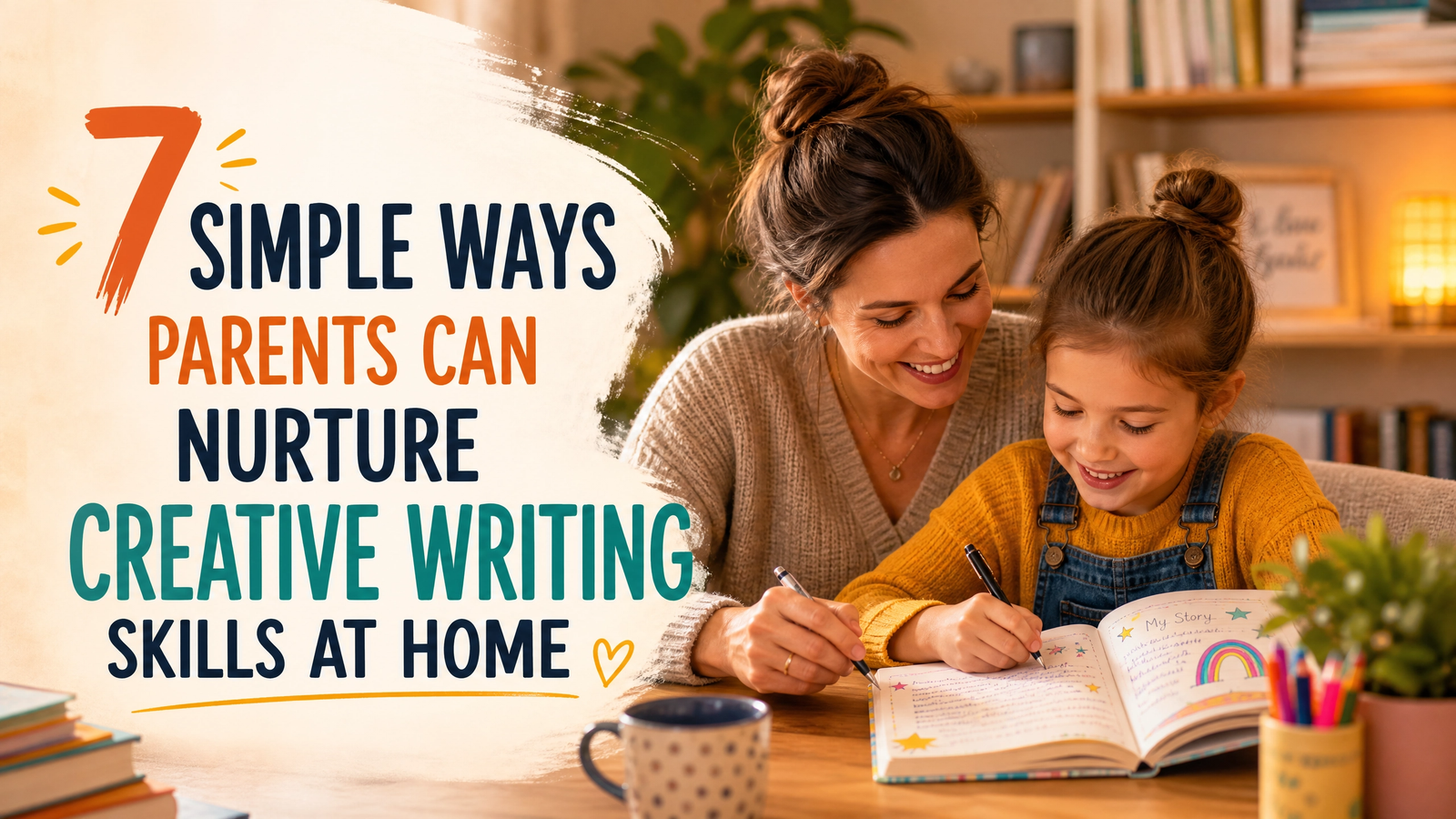
7 Simple Ways Parents Can Nurture Creative Writing Skills at Home
By JNR Epic Tales | 6 min read | Parent Guide
You don’t need to be a teacher or a writer to help your child fall in love with writing. In fact, the best thing you can do is step back, provide simple tools, and let their imagination lead.
Research from the National Council of Teachers of English shows that children who write creatively at home develop stronger reading comprehension, better vocabulary, and higher confidence in school. Yet many parents ask: “How to help my child with creative writing without turning it into a chore?”
Here are 7 simple, pressure-free strategies that work for kids ages 7-12.
📖 In This Guide
1. Create a “No Rules” Writing Space

What to do: Set up a small corner with notebooks, colorful pens, and a comfortable chair. Let your child decorate it with their drawings or favorite book covers.
Why it works: A dedicated space signals that writing is special, not a school assignment. The “no rules” rule means no grading, no correcting, and no pressure.
✨ Try this tonight: Spend 10 minutes decorating a simple cardboard box as a “Story Treasure Chest” filled with blank paper and fun pens.
2. Use Story Starters (Not Writing Prompts)
What to do: Instead of “Write about your summer,” try: “The dog opened the fridge and found…” or “My backpack started glowing because…”
Why it works: Open-ended prompts can feel overwhelming. Story starters give kids a launching pad without dictating the entire story.
📝 5 Story Starters to Print:
- “The last slice of pizza disappeared. The suspect was…”
- “My teacher handed me a note that said: ‘You are the new principal.'”
- “Under my bed, I found a tiny door. I opened it and…”
- “The new kid at school had three shadows.”
- “My pet started talking. The first thing it said was…”
3. Let Them Copy Their Favorite Books
What to do: Encourage your child to copy a page from their favorite book by hand or type it out.
Why it works: This is called “copywork” – a classical education technique. Children absorb sentence structure, punctuation, and rhythm without explicit instruction. Research shows copywork improves writing fluency faster than original composition.
4. Play “What Happens Next?”
What to do: Read a story together and pause at a suspenseful moment. Ask: “What do you think happens next?” Let them tell you, then read the actual ending. Compare!
Why it works: This builds narrative intuition – understanding how stories are structured. It’s low-pressure because they’re speaking, not writing.
5. Celebrate Ideas, Not Spelling
What to do: When your child shares a story, respond to the content first. Say: “I love how the dragon outsmarted the knight!” not “You spelled ‘knight’ wrong.”
Why it works: Premature correction kills creativity. The National Writing Project found that children who receive positive feedback on ideas first become more prolific writers and naturally improve mechanics over time.
💬 What to say instead of “Fix your spelling”:
“Tell me more about that character!”
“What happens after this?”
“This part made me laugh. How did you come up with it?”
6. Create a “Story Jar” for Rainy Days
What to do: Write simple story elements on slips of paper: characters (a shy dragon), settings (a floating market), problems (the bridge broke). Let your child draw 3-4 slips and combine them into a story.
Why it works: Decision fatigue is real for young writers. The jar removes the hardest part (starting) so they can focus on the fun part (imagining).
7. Write Together (Yes, You Too!)
What to do: Set a timer for 10 minutes. Everyone writes silently – parents included. No phones, no interruptions. After the timer, share one sentence from what you wrote.
Why it works: Modeling matters. When your child sees you writing (a shopping list, a journal entry, an email), they learn that writing is a normal, valuable adult activity – not just homework.
📥 Free Printable: Story Starter Cards
Subscribe to get 20 printable story starter cards + our complete activity pack!
📧 Get Free Printables →Quick Reference: 7 Ways at a Glance
| Strategy | Time Needed |
|---|---|
| 1. No Rules Writing Space | Setup: 30 min |
| 2. Story Starters | 5 min |
| 3. Copy Favorite Books | 10-15 min |
| 4. What Happens Next? | 5 min |
| 5. Celebrate Ideas | Immediate |
| 6. Story Jar | Setup: 20 min |
| 7. Write Together | 10-15 min |
JNR Epic Tales creates stories, puzzles, and parent resources for kids ages 7-12.
Visit our website for more free writing activities.
Advertisement
Explore RTL English learning resources
RTL English sells levelled, printable reading workbooks for children, with notes for parents. Here is one level from our affiliate partner’s range.
Level 6 (Proficient Reader) is aimed at children aged 8–10, according to the seller.
Advertisement · This is an affiliate link. We may earn a commission if you purchase. We have not tested this product; individual results vary. Please check the current price and the seller’s terms before buying.