
Why 65% of Children Struggle With Reading: The Early Learning Gap Most Parents Do Not Know Exists
By third grade, 65% of American children are reading below grade level. By high school, millions will never catch up. The achievement gap widens into a chasm. Yet the root cause of this crisis is not bad schools, lazy teachers, or unmotivated students — though those factors may play minor roles. It is something far simpler and far more preventable: most children are not receiving the structured early literacy preparation they need before age six. The window of opportunity is open, and then it closes.
In this comprehensive, evidence-based guide, you will discover why the first five years are the most critical for reading development, what research reveals about how young brains actually learn to read (it may surprise you), and a proven home learning system that gives children ages 4-6 the structured, step-by-step foundation they need to become confident, enthusiastic readers. The science is clear. The tools exist. The only question is whether you will act on them.
What You Will Learn
- The Reading Crisis: By the Numbers
- Why Ages 4-6 Are the Critical Window for Brain Development
- Reading Readiness Assessment: Where Does Your Child Stand?
- How the RTL English Level 2 System Works
- The Science of Phonological Awareness: The Hidden Foundation
- Building Vocabulary Through Rich Language Experiences
- The Role of Fine Motor Development in Early Literacy
- Research on Early Literacy and Brain Development
- How RTL Compares to Other Reading Programs
- Getting Started: Your Child’s Reading Journey
- Frequently Asked Questions
The Reading Crisis: By the Numbers
The statistics on childhood literacy in America are sobering — not just disappointing but genuinely alarming. According to the National Assessment of Educational Progress (NAEP) 2024 report, only 35% of fourth-grade students read at or above proficiency. The remaining 65% — nearly two-thirds of all children — are struggling. These numbers have remained stubbornly consistent for decades despite billions in educational spending, new curricula, and countless reform initiatives. The crisis is not improving because we are treating symptoms, not causes.
But here is what most parents do not realize, and what the educational establishment rarely emphasizes: these struggles are not inevitable. Research from the National Institutes of Health (2023) shows that 88% of reading difficulties can be prevented with appropriate early literacy instruction before age six. Not remediated. Not accommodated. Prevented. The problem is not that children cannot learn to read — it is that they are not receiving the right kind of preparation during the most critical developmental window. By the time schools identify the problem, the window has often closed.
The consequences of poor reading extend far beyond academics. They cascade across every domain of life. Children who struggle with reading are four times more likely to drop out of high school (Annie E. Casey Foundation, 2024). They are more likely to experience anxiety and depression related to school performance. They are less likely to pursue higher education and career opportunities. They are at higher risk for behavioral problems stemming from academic frustration. The effects are not just educational; they are existential.
Dr. Sally Shaywitz, co-director of the Yale Center for Dyslexia and Creativity, has spent decades studying reading development. Her research demonstrates that reading difficulties can be identified and addressed as early as age four — but only if parents and educators know what to look for and how to intervene. “Waiting until third grade to address reading difficulties is like waiting until a fire has spread to call the fire department,” she explains. “The damage is already done, and the remediation is exponentially harder.”
Why Ages 4-6 Are the Critical Window for Brain Development
Neuroscience has revealed that the human brain undergoes extraordinary development between ages four and six, particularly in the regions responsible for language and literacy. During this period, the brain forms neural connections at a rate of up to one million new synapses per second — a pace never again achieved in life. This is not a metaphor. This is measurable biological reality.
Dr. Patricia Kuhl, co-director of the Institute for Learning and Brain Sciences at the University of Washington, describes ages 4-6 as a “sensitive period” for phonological development — the ability to hear, identify, and manipulate the sounds in spoken language. This phonological awareness is the single strongest predictor of later reading success, stronger even than IQ or socioeconomic status. It is the foundation upon which all reading is built.
Children who develop strong phonological awareness before first grade have a 95% probability of becoming successful readers. Children who do not have only a 35% chance of catching up — even with intensive, expensive intervention. The window does not close completely at age six, but it becomes significantly harder to build these foundational skills. The brain’s plasticity declines, and what could have been built effortlessly now requires struggle.
What does effective early literacy instruction look like? According to the National Reading Panel (2024 update), it includes five core components that must be taught explicitly, systematically, and in sequence:
| Component | What It Means | Age 4-6 Activity Example |
|---|---|---|
| Phonemic Awareness | Hearing and manipulating individual sounds in spoken words | Rhyming games, sound blending, segmenting words into phonemes |
| Phonics | Connecting sounds to written letters | Letter-sound correspondence, decoding simple words |
| Fluency | Reading smoothly, accurately, and with expression | Guided reading practice, repeated readings |
| Vocabulary | Understanding word meanings in context | Word-rich conversations, explicit vocabulary instruction |
| Comprehension | Understanding and interpreting what is read | Story discussion, prediction, questioning, summarizing |
The challenge for parents is knowing how to teach these components effectively at home. Most parents are not teachers. They want to help their children develop reading skills, but they lack the training, materials, and structured guidance to do so systematically. This is where a well-designed home learning system becomes not just helpful but essential.
Reading Readiness Assessment: Where Does Your Child Stand?
📚 Is Your Child Ready to Start Reading?
Answer these 8 questions about your child’s current skills to receive a personalized reading readiness assessment and recommendations.
1. Can your child recognize and name most letters of the alphabet (uppercase and lowercase)?
2. Does your child enjoy being read to and show active interest in books?
3. Can your child recognize rhyming words (cat/hat, dog/frog)?
4. Does your child try to “read” books by telling the story from pictures?
5. Can your child hear the beginning sounds in words (what sound does “ball” start with)?
6. Does your child hold books correctly and turn pages appropriately?
7. Can your child write or trace some letters of the alphabet?
8. Does your child ask what words say or mean when encountered in daily life?
How the RTL English Level 2 System Works
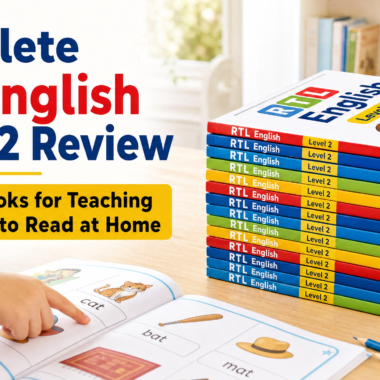
The RTL English Level 2 Home Learning Pack was designed specifically for children ages 4-6 who are beginning their reading journey. Trusted since 1996, the system has helped thousands of children develop strong early literacy skills through a structured, parent-friendly approach that requires no teaching experience — just consistent practice and the willingness to follow a proven system.
What Is Included
36 Structured Workbooks: Each workbook contains carefully sequenced activities that build phonemic awareness, letter recognition, sound-letter correspondence, and early decoding skills. The workbooks progress from simple (identifying letters) to complex (blending sounds to read simple words), ensuring that children experience success at every step. Success builds confidence; confidence builds motivation.
979+ Learning Activities: The activities are designed to be engaging and developmentally appropriate. They include tracing, matching, coloring, cutting, and pasting — all the hands-on activities that young children naturally love, strategically designed to build reading readiness. Each activity serves a dual purpose: engagement and education.
1,767 Exercises: Varied practice ensures mastery without boredom. Children encounter the same skills in different formats, strengthening neural pathways and building flexible understanding. This repetition is not boring — it is essential for neural consolidation.
810 Parent Teaching Notes: This is where RTL English truly distinguishes itself from competitors. Each lesson includes clear, simple instructions for parents — no teaching degree required. The notes explain what skill is being developed, why it matters for reading, and exactly how to guide your child through the activity. You will never feel lost or uncertain.
Give Your Child the Reading Foundation They Deserve
36 workbooks, 979+ activities, 810 parent notes — everything you need for $58.76. The cost of one tutoring session for materials that last an entire year.
Get the Level 2 Home Learning Pack → $58.76, instant download
Phonological awareness — the ability to recognize and manipulate sounds in spoken language — is the foundation upon which all reading skills are built. Research consistently shows that children with strong phonological awareness before first grade have a 95% probability of becoming successful readers. Without it, children struggle to connect written letters to spoken sounds, making decoding virtually impossible.
The RTL English Level 2 system systematically develops phonological awareness through carefully sequenced activities. Children begin with simple listening games that help them hear individual sounds in words. They progress to rhyming activities that strengthen their awareness of sound patterns. They then learn to segment words into individual sounds and blend sounds together to form words. This systematic approach mirrors the research-based sequence recommended by the National Reading Panel — not guesswork, but science.
Dr. Marilyn Adams, author of the landmark book “Beginning to Read,” emphasizes that phonological awareness cannot be developed through incidental exposure alone. “It requires intentional, structured activities that explicitly teach children to attend to the sounds in words,” she writes. “You cannot pick this up by osmosis.” The RTL English system provides exactly this structure, with parent notes that explain the purpose of each activity and how it contributes to reading development.
Building Vocabulary Through Rich Language Experiences
While phonics instruction teaches children how to decode words, vocabulary development ensures they understand what they read. Children who enter school with larger vocabularies have significant advantages in reading comprehension, academic achievement, and even social-emotional development. The Matthew Effect applies here: the rich get richer, and the poor fall further behind.
The RTL English system incorporates vocabulary building into every lesson. The 979+ activities include picture-word matching, semantic categorization, and contextual learning experiences. The parent teaching notes encourage rich conversations about words, their meanings, and how they connect to children’s lived experiences. Vocabulary is not taught in isolation but embedded in meaningful contexts.
Research from the University of Kansas (Hart and Risley, 2024 update) confirms that children who hear more words in their early years develop significantly larger vocabularies — and the gap appears before age three. The RTL English activities are designed to spark these conversations, with prompts that encourage parents to talk with their children about the words they encounter. Every lesson is an opportunity for language-rich interaction.
The Role of Fine Motor Development in Early Literacy
An often-overlooked component of early literacy is fine motor development. The physical act of writing — holding a pencil, forming letters, controlling pressure — activates brain regions that support reading development in ways that typing cannot replicate. The RTL English system’s emphasis on tracing, writing, and hands-on activities serves a dual purpose: building fine motor skills while developing literacy.
Dr. Karin James, a cognitive neuroscientist at Indiana University, has demonstrated through fMRI research that handwriting activates the reading network in ways that typing does not. Children who practice forming letters by hand show stronger letter recognition and reading skills than those who only type or swipe. The RTL English workbooks ensure children get this critical handwriting practice — not as an afterthought but as an integrated component of every lesson.
Research on Early Literacy and Brain Development
The RTL English system is grounded in decades of research on how children learn to read. Understanding this research helps parents appreciate why a structured, systematic approach is so important during the early years.
A landmark 2024 study from Stanford University’s Graduate School of Education used functional magnetic resonance imaging (fMRI) to examine how young children’s brains process written language. Researchers found that children who received structured phonics instruction before age six showed dramatically stronger activation in the left temporoparietal region — the brain’s “reading center” — compared to children who received only whole-language or incidental literacy exposure. The difference was visible on brain scans. It was not theoretical; it was biological.
Dr. Bruce McCandliss, the study’s lead author, explained: “The brain does not naturally develop reading circuits. Written language is a human invention, and learning to read requires explicit instruction that builds neural pathways connecting visual symbols to speech sounds. The earlier this instruction begins, the stronger and more efficient these pathways become.” The RTL English Level 2 system provides exactly this explicit, systematic instruction.
How RTL Compares to Other Reading Programs
| Feature | RTL English Level 2 | Hooked on Phonics | ABCmouse | Private Tutor |
|---|---|---|---|---|
| Structured workbooks | 36 included, print at home | Physical books (additional cost) | Digital only, no physical materials | Varies widely |
| Parent teaching notes | 810 detailed notes with scripts | Minimal guidance | None — self-directed | N/A — tutor leads |
| Screen-free | Yes — hands-on pencil activities | Partially — mix of physical and digital | No — entirely screen-based | Varies |
| Age appropriate (4-6) | Specifically designed for this range | 4-6 range but not specialized | 2-8 — very broad, less targeted | Depends on tutor specialty |
| Activities count | 979+ unique activities | 200+ activities | 10,000+ (but many repetitive)\)),Varies | |
| One-time cost | $58.76 (no subscription) | $50-100 (plus ongoing) | $60/year subscription | $50-100/hour |
| 60-day guarantee | Yes — unconditional | 30-day refund | No — subscription model | Varies |
RTL English offers a unique combination of comprehensive content, parent support, screen-free design, and affordable pricing. The 810 parent teaching notes are particularly valuable — they transform parents into effective literacy coaches without requiring any teaching background.
Getting Started: Your Child’s Reading Journey
Starting your child’s reading journey with RTL English Level 2 is simple and immediate:
Get instant access — no shipping, no waiting. The digital format means you can start today, not next week. Your child’s reading journey begins the moment you click “download.”
This 10-minute overview explains how the system works and how to use the teaching notes effectively. It is the only preparation you need.
Each session takes 15-20 minutes. The teaching notes guide you through every activity. You will know exactly what to do and why.
Aim for 3-5 sessions per week. Short, regular practice produces better results than occasional long sessions. Consistency matters more than duration.
The workbooks are designed so children experience success at every step. Celebrate that success to build confidence and motivation. Every small win is a step toward lifelong literacy.
Start Your Child’s Reading Journey Today
Trusted since 1996. 36 workbooks. 979+ activities. 810 parent notes. Just $58.76 with a 60-day guarantee. Your child’s future reader identity starts here.
Frequently Asked Questions
What age is RTL English Level 2 designed for?
Level 2 is specifically designed for children ages 4-6 who are beginning their reading journey. The activities are developmentally appropriate for this age range, with parent notes that help you adjust for children who need more support or more challenge. If your child is already reading simple words independently, Level 3 may be more appropriate.
Do I need teaching experience to use this program?
Not at all. The 810 parent teaching notes explain every activity, every skill, and every teaching strategy in plain language. You will know exactly what to do, what to say, and how to help your child if they struggle. Thousands of parents with no teaching background have successfully used this system to teach their children to read.
How long does each lesson take?
Each workbook session takes 15-20 minutes, which is the optimal attention span for children ages 4-6. The program recommends 3-5 sessions per week, making it easy to fit into busy family schedules. At this pace, most families complete the 36 workbooks in 8-12 weeks — a third of a school year.
Is this a digital download or physical product?
The Level 2 Home Learning Pack is a digital product with instant download. This means you can start today — no waiting for shipping. Print the workbooks as needed, reprint favorite activities for extra practice, and access everything on any device. You never run out of materials.
What if it does not work for my child?
RTL English offers a 60-day satisfaction guarantee. If you are not completely satisfied, you can request a full refund. With a 4.8/5 star rating from thousands of families and a trusted reputation since 1996, RTL English stands behind its products. Get the Level 2 pack here with complete confidence.
The Science Is Clear. The Tools Are Ready.
Your child’s reading journey begins with a single decision. The research shows that early intervention works. The RTL English system provides the roadmap. The only missing piece is your commitment to start.
Get the Level 2 Home Learning Pack → $58.76, 60-day guarantee