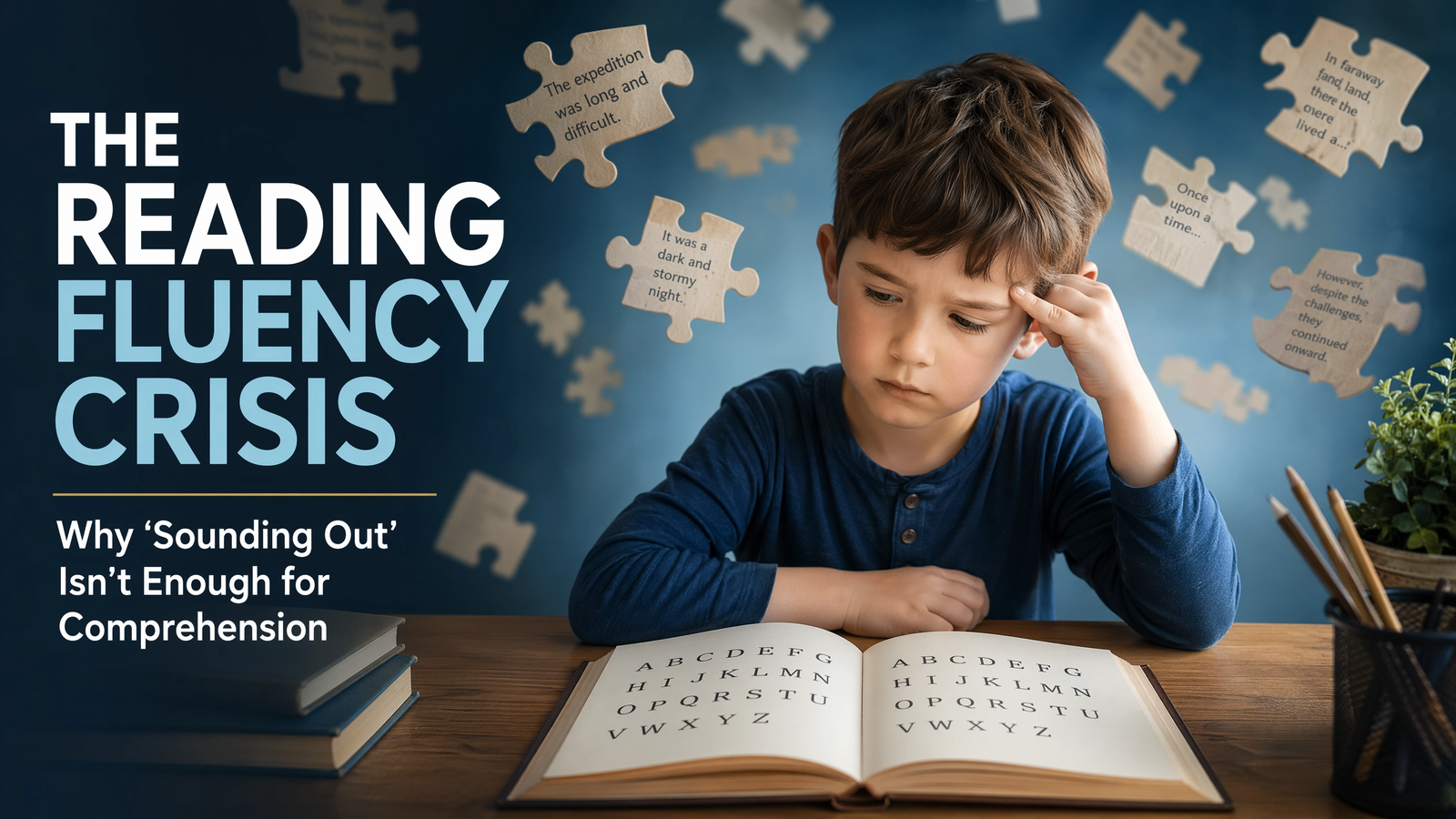
The Reading Fluency Crisis: Why Children Who Can “Sound Out” Words Still Cannot Understand What They Read
Your child reads every word perfectly. But when you ask what they just read, they give you a blank stare. This is the hidden epidemic affecting millions of children — and most parents don’t even know it exists.
What You Will Learn
- The Decoding-Comprehension Gap: A Hidden Epidemic
- Why Fluency Is the Bridge Between Decoding and Understanding
- Reading Fluency Self-Assessment
- Inside RTL English Level 3: The Fluency-First System
- The Three Components of Reading Fluency
- Research on Fluency Instruction
- How Level 3 Compares to Other Programs
- Supporting Your Child’s Fluency at Home
- Frequently Asked Questions
Your child reads the sentence perfectly: “The exhausted marathon runner collapsed at the finish line.” Every word pronounced correctly. The pacing is reasonable. There is even some appropriate expression. But when you ask, “Why did the runner collapse?” they stare blankly. They decoded every word but comprehended nothing. This is not a rare problem — it is epidemic.
The National Assessment of Educational Progress (NAEP) 2024 report reveals a disturbing pattern that should concern every parent: while 68% of fourth-graders can read words accurately, only 35% can comprehend grade-level text. That gap — 33 percentage points — represents millions of children who can “read” without understanding. They have mastered the mechanics of reading but missed the point entirely.
Dr. Timothy Shanahan, Distinguished Professor Emeritus at the University of Illinois at Chicago and past president of the International Literacy Association, calls this the “fourth-grade slump.” Children who appeared to be reading successfully suddenly struggle because the cognitive demands of comprehension exceed their capacity. They have been word-calling, not reading. And the educational system often fails to distinguish between the two until it is too late.
The root cause is insufficient reading fluency. Fluent readers process words automatically, freeing cognitive resources for comprehension. Struggling readers expend all their mental energy on decoding, leaving nothing for understanding. It is like trying to have a conversation while sounding out each syllable — by the time you finish a sentence, you have forgotten how it began. The cognitive load is simply too high.
Why Fluency Is the Bridge Between Decoding and Understanding
Reading fluency has three components: accuracy (reading words correctly), rate (reading at an appropriate speed), and prosody (reading with expression that reflects meaning). When all three components are strong, comprehension naturally follows. When any component is weak, comprehension suffers — sometimes dramatically.
Research from the National Reading Panel (2024 update) confirms that fluency instruction significantly improves reading comprehension. A landmark meta-analysis of 52 studies found that students who received fluency-focused instruction showed average comprehension gains of 0.7 standard deviations — equivalent to approximately one year of reading growth. This is not a small effect; it is transformative.
The mechanism is straightforward. When word recognition becomes automatic — when children recognize words in less than 200 milliseconds without conscious effort — their brains can devote full attention to meaning. They can make connections between ideas, draw inferences, and build mental models of what they are reading. Without automaticity, these higher-level processes are impossible. The brain has limited processing capacity; it cannot do everything at once.
The RTL English Level 3 system was designed specifically to build this bridge. While Level 2 teaches children to decode, Level 3 transforms that decoding ability into genuine reading fluency through carefully structured practice, comprehension strategies, and engaging texts that children actually want to read.
Reading Fluency Self-Assessment
📖 Is Your Child a Fluent Reader?
Answer these 5 questions to assess your child’s reading fluency level and get personalized recommendations.
Inside RTL English Level 3: The Fluency-First System
RTL English Level 3 is designed for children ages 5-7 who have mastered basic phonics and are ready to develop reading fluency. The system builds on the decoding skills developed in Level 2 with a comprehensive focus on fluency, comprehension, and reading enjoyment. It is not more of the same — it is the logical next step.
36 Structured Workbooks: The Level 3 workbooks progress systematically from simple repeated-text pattern books to more complex narratives. Early workbooks feature controlled vocabulary with high-frequency words and decodable text, allowing children to build confidence. Later workbooks introduce varied sentence structures, dialogue, richer vocabulary, and longer passages that build reading stamina.
790+ Learning Activities: Activities are designed to build all three components of fluency. Accuracy activities include word recognition drills and phonics review. Rate-building activities use timed repeated readings with progress tracking — children see their words-per-minute improve week by week. Prosody activities focus on punctuation cues, dialogue tags, and expressive reading that brings text to life.
1,121 Parent Teaching Notes: The parent notes for Level 3 include specific fluency-building strategies that most parents have never learned: how to model fluent reading, how to use echo reading effectively, when to prompt for self-correction versus when to let the child struggle productively, and how to discuss text meaningfully. These notes transform parents into effective fluency coaches.
The Three Components of Reading Fluency
Accuracy (Word Recognition): Children must recognize words correctly. Errors in decoding disrupt comprehension because each mistake forces the brain to reinterpret meaning. Level 3 includes systematic phonics review and high-frequency word practice to ensure accuracy before speed.
Rate (Automaticity): Children must read at an appropriate speed — not so fast that they skip words, not so slow that they lose meaning. The target for end of first grade is 45-60 words per minute; for end of second grade, 80-100 words per minute. Level 3 includes timed repeated readings and progress tracking to build rate systematically.
Prosody (Expression): Children must read with appropriate phrasing and intonation that reflects meaning. Prosody is the musicality of reading — the rise and fall of the voice that signals punctuation, emotion, and emphasis. Level 3 activities include echo reading, reader’s theater, and recorded readings that children can listen to and improve.
Research on Fluency Instruction
The RTL English Level 3 approach is grounded in decades of research on reading fluency. Key findings include:
Repeated reading works. A 2024 meta-analysis by Dr. Melanie Kuhn at Boston University found that repeated reading programs produce average fluency gains of 1.5 grade levels over 12 weeks. The effect is strongest when combined with comprehension monitoring and feedback. Reading the same text multiple times builds automaticity without requiring new decoding challenges.
Modeling matters. Children who hear fluent reading regularly develop better prosody and comprehension. Dr. Jay Samuels at the University of Minnesota demonstrated that even 10 minutes of daily modeled reading significantly improves children’s fluency. The brain learns by imitation; fluent models provide the template.
Rate and comprehension are linked. Research consistently shows a strong correlation between reading rate and comprehension. Children reading below 45 words per minute in first grade are at significant risk for reading difficulties. By third grade, the threshold rises to 100 words per minute for adequate comprehension. These are not arbitrary numbers; they are empirically derived benchmarks.
Self-monitoring is teachable. Children can learn to notice when their reading does not make sense and self-correct. This metacognitive skill is a hallmark of skilled reading and is explicitly taught in the Level 3 workbooks through comprehension checks and error detection activities.
How Level 3 Compares to Other Programs
| Feature | RTL Level 3 | Reading Eggs | Raz-Kids | Private Tutoring |
|---|---|---|---|---|
| Fluency focus | Core component, systematically taught | Secondary, mostly games | Assessment only, no instruction | Varies by tutor |
| Parent guidance | 1,121 detailed teaching notes | Minimal, self-directed | Minimal, self-directed | N/A |
| Comprehension strategies | Explicitly taught and practiced | Implicit, embedded in games | Some, but not systematic | Varies widely |
| Screen-free | Yes — hands-on workbook activities | No — entirely screen-based | No — screen-based reading | Varies |
| Cost | $58.76 one-time | $70/year subscription | $120/year subscription | $50-100/hour |
| Guarantee | 60-day satisfaction guarantee | 30-day refund | No | Varies |
RTL Level 3 offers the most comprehensive fluency instruction at the lowest cost, with the added benefit of parent guidance that no other program provides. The one-time payment means you own the materials forever — no recurring subscription fees.
Supporting Your Child’s Fluency at Home
In addition to the Level 3 workbooks, parents can support fluency development through daily practices that take only a few minutes:
Read aloud daily. Continue reading to your child even after they begin reading independently. Hearing fluent models builds their mental template for what reading should sound like. Choose books slightly above their reading level — the listening comprehension zone.
Practice echo reading. You read a sentence with expression, then your child reads the same sentence, matching your phrasing and expression. This builds prosody directly and takes only 3-5 minutes per session.
Use audiobooks. Listening to skilled narrators exposes children to fluent, expressive reading. Follow along with the printed text for maximum benefit — the combination of auditory and visual input strengthens neural pathways.
Discuss what you read. Ask questions, make predictions, and connect stories to your child’s experiences. These conversations build the comprehension skills that give reading its purpose. Never assume that understanding is automatic; always check for meaning.
Build Your Child’s Reading Fluency Today
36 workbooks, 790+ activities, 1,121 parent notes — instant download for $58.76. Plus a 60-day money-back guarantee.
Get Level 3 Home Learning Pack →Frequently Asked Questions
How do I know if my child is ready for Level 3?
Level 3 is appropriate for children who can read simple CVC words (cat, sun, hop) and recognize common sight words. Typically ages 5-7. If your child is still learning letter sounds, start with Level 2. If they are reading simple sentences but struggling with speed or expression, Level 3 is exactly what they need.
How long does Level 3 take to complete?
Most families complete Level 3 in 10-14 weeks at 3-5 sessions per week. Each session takes 20-25 minutes. You can adjust the pace to match your child’s needs — some children move faster, others need more repetition. Both are fine.
Will this help my child who reads slowly but accurately?
Absolutely. Slow but accurate reading is a classic fluency issue. The repeated reading protocol and rate-building activities in Level 3 are specifically designed to increase reading speed while maintaining accuracy. Most children see measurable improvement within 3-4 weeks.
What comes after Level 3?
After completing Level 3, most children move to Level 4 (Independent Reader), which focuses on reading independence, advanced comprehension, and vocabulary development. The RTL curriculum provides a clear pathway from beginning reader to literary analysis.
Is there a guarantee?
Yes, RTL English offers a 60-day satisfaction guarantee on all products. If you are not completely satisfied for any reason, you can request a full refund within 60 days of purchase. Order with confidence here.
Transform Your Child Into a Fluent Reader
The research is clear. The tools are ready. The only missing piece is your decision to begin.
Get RTL Level 3 Now → $58.76, 60-day guarantee