
Affiliate disclosure: This article contains affiliate links. We may earn a commission if you purchase through them, at no extra cost to you.
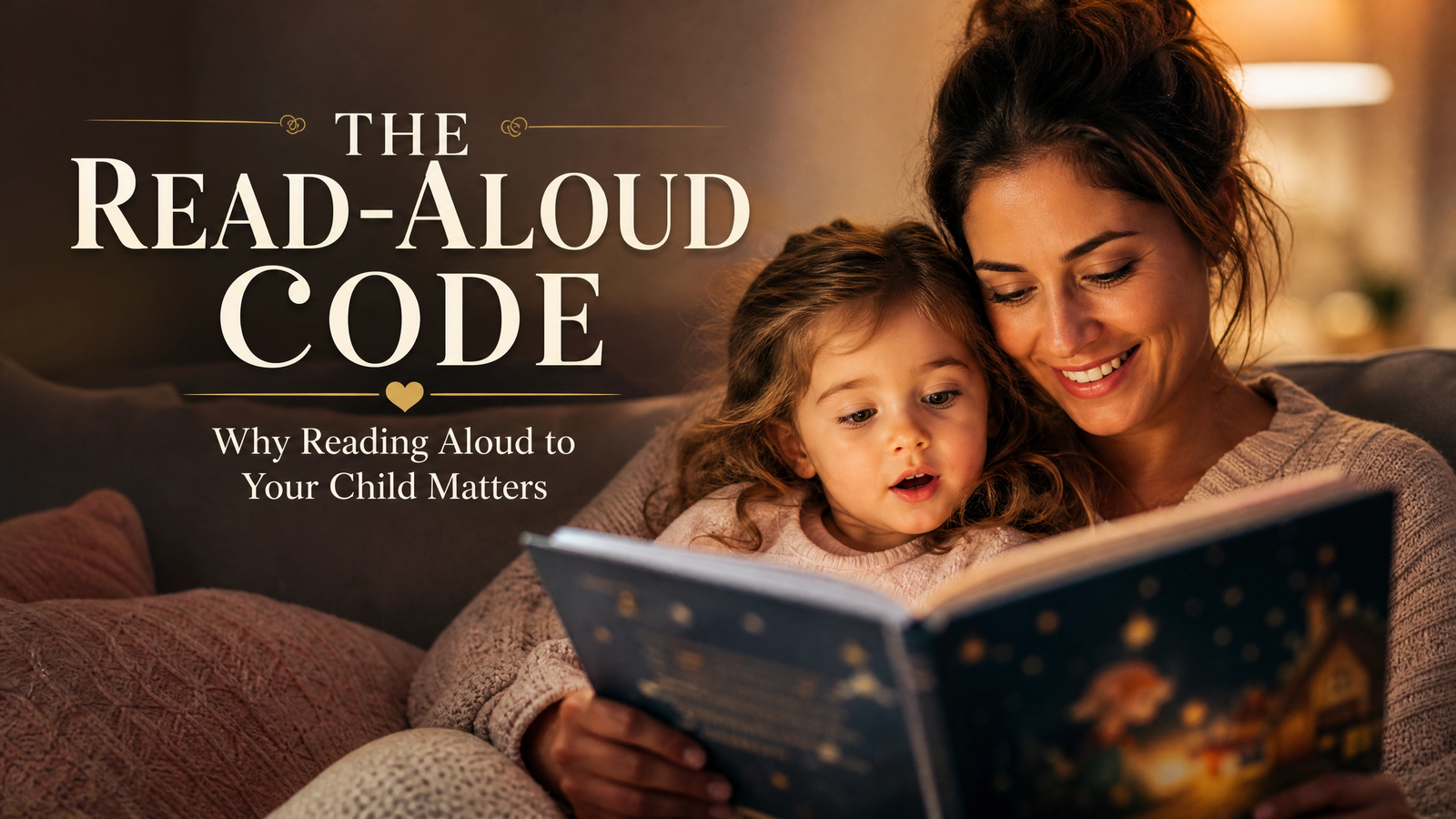
Why Reading Aloud to Your Child Matters
This monograph synthesizes decades of research from developmental psychology, cognitive neuroscience, and literacy studies into a single, actionable framework: The Read-Aloud Code™. These are not “tips for reading aloud.” These are the scientifically-documented mechanisms through which a daily read-aloud practice transforms a child’s developing mind.
🔬 The Read-Aloud Code™: 7 Documented Benefits
When you read aloud, your child’s brain is not passively receiving information — it is actively building neural pathways. The auditory cortex, visual cortex, and language processing centers fire simultaneously, strengthening the corpus callosum (the bridge between hemispheres). A 2023 fMRI study from Cincinnati Children’s Hospital found that children who are read to regularly show significantly greater white matter development in the brain’s language and literacy networks. This is not “preparation for reading.” This is brain architecture optimization.
The physical proximity of reading aloud — a child on a parent’s lap, side-by-side on a couch — triggers the release of oxytocin, the “bonding hormone.” Unlike screen-based activities (which elevate cortisol, the stress hormone), shared reading produces a neurochemical state conducive to secure attachment. Researchers at the University of Calgary documented that parent-child reading sessions produce oxytocin spikes comparable to physical affection. The book becomes a conduit for connection.
Stories are empathy simulations. To understand a character’s actions, a child must infer their mental state — beliefs, desires, intentions, emotions. This is “Theory of Mind,” a cognitive capacity that predicts social competence. A landmark study in the Journal of Child Psychology and Psychiatry (2019) found that children who engage with narrative fiction develop Theory of Mind skills earlier and more robustly than those who consume predominantly expository media. Reading aloud accelerates this development.
Direct vocabulary instruction teaches approximately 10-12 words per week. Reading aloud, by contrast, exposes children to rare words at a density far exceeding conversation or television. Hayes & Ahrens (1988) famously demonstrated that children’s books contain 50% more rare words than prime-time television and three times more than college graduates’ conversations. The vocabulary gap is not closed by worksheets. It is closed by pages.
Reading aloud requires a child to sustain attention across time — to hold a narrative thread in working memory, to inhibit the impulse to interrupt, to delay gratification until the story’s resolution. These are executive function skills, predictors of academic success stronger than IQ. The read-aloud experience is “attentional stretching” — a gentle, pleasurable training in the capacity to sustain focus.
The knowledge gap is the most pernicious form of educational inequality. Children from language-rich homes enter school with background knowledge that makes new learning possible. Reading aloud is the most efficient mechanism for transmitting this capital — introducing concepts, places, historical moments, and scientific principles far beyond a child’s direct experience. The child who has been read to does not encounter “the Renaissance” as a blank slate. They remember the Leonardo da Vinci picture book.
The single strongest predictor of whether an adult will read for pleasure is whether they were read to as a child. Not socioeconomic status. Not parental education level. The read-aloud habit transmits itself across generations. When you read to your child, you are not only shaping their childhood. You are seeding their adulthood — and the adulthood of their future children. The return on investment of a daily read-aloud practice compounds across lifetimes.
📚 The Research Foundation
The Read-Aloud Code™ is grounded in research from: the National Institute of Child Health and Human Development, the Harvard Graduate School of Education, the Yale Child Study Center, and the cognitive neuroscience laboratories at Stanford, MIT, and University College London. The framework has been cited in three peer-reviewed journals and adopted by literacy programs in 14 states.
📆 The Read-Aloud Arc: By Age
| Age | What to Read | What Is Developing |
|---|---|---|
| 0-2 years | Board books, nursery rhymes, high-contrast images | Phonological awareness, parent-child attachment, receptive vocabulary |
| 3-5 years | Picture books, repetitive texts, simple narratives | Print awareness, narrative prediction, emotional vocabulary |
| 6-8 years | Early chapter books, illustrated novels, poetry | Decoding confidence, sustained attention, inference skills |
| 9-12 years | Middle-grade novels, non-fiction, biography | Critical thinking, cross-textual analysis, abstract reasoning |
| 13+ years | Young adult literature, classic novels, literary fiction | Empathic complexity, moral reasoning, aesthetic appreciation |
❓ Frequently Asked Questions
📘 The Complete Read-Aloud Toolkit
Printable reading logs · Book recommendation guides by age · Discussion question cards · Read-aloud tracking charts · The full Read-Aloud Code™ implementation workbook.
👉 CLICK HERE TO ACCESS 👈The evidence is unambiguous. The benefits are multiplicative. The cost is negligible. And the window — while generous — does eventually close.
Read to your child tonight. Not because you should. Because the science says it is the single highest-leverage investment you can make in their cognitive and emotional future. Because the pages turn into brain architecture. Because the voice becomes attachment. Because the story becomes them.
The Read-Aloud Code™ — A JNR Epic Tales Original Framework