literary analysis for kids

Why Most Middle Schoolers Cannot Analyze Literature: The Critical Reading Gap That Starts in Elementary School

0 Shares
0
0
0
Why Most Middle Schoolers Cannot Analyze Literature: The Critical Reading Gap That Starts in Elementary School

Why Most Middle Schoolers Cannot Analyze Literature: The Critical Reading Gap That Starts in Elementary School

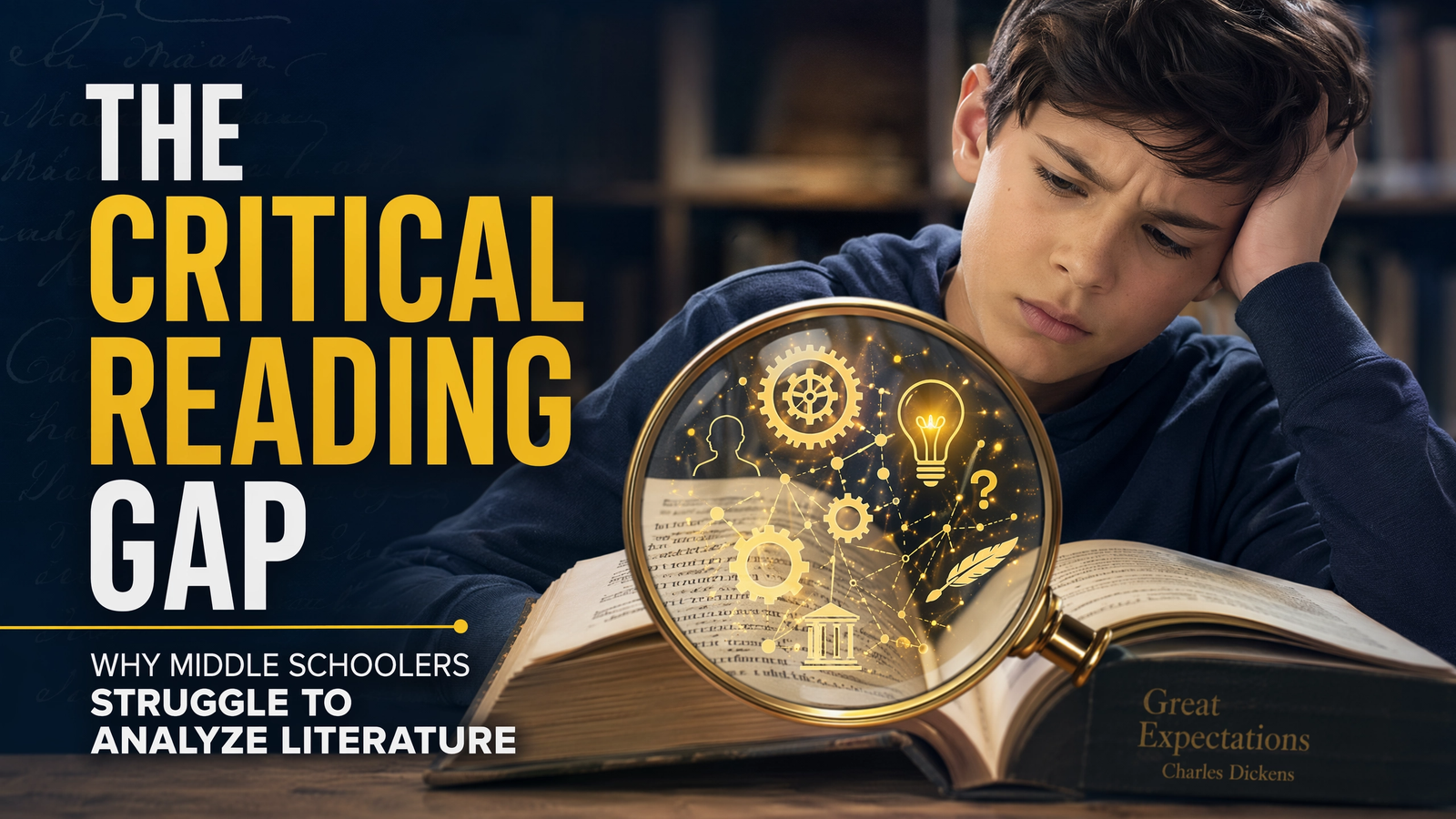
“I do not get what the author is trying to say.” This confession from a seventh-grader echoes in classrooms nationwide. Students who decoded proficiently in elementary school suddenly face literature analysis and draw blanks. They can read the words but cannot interpret meaning, identify themes, or evaluate author craft. This critical reading gap does not appear in middle school — it originates in the missing analytical instruction of upper elementary years.

68%Can decode words accurately
35%Can analyze text critically
33%The analysis gap

The Analysis Gap: What Happens in Middle School

Walk into any middle school English classroom, and you will witness a troubling phenomenon. Students who sailed through elementary reading suddenly hit a wall. They can tell you what happened in a story — the plot, the sequence of events, the basic facts. But when asked why the author made a particular choice, or what theme the story conveys, or how the setting influences the mood, they stare blankly. They have mastered comprehension but never learned analysis.

Most reading instruction stops at comprehension — did you understand what happened? But literary analysis asks fundamentally different questions: Why did the author choose this specific word instead of a synonym? What perspective is missing from this narrative? How does the structure of the text create meaning? These analytical skills are rarely taught before middle school, yet research from the National Council of Teachers of English shows they should begin by age 9.

Comprehension answers “what happened.” Analysis answers “why it matters.” Children who only learn comprehension enter middle school unprepared for the demands of analytical reading.

The gap between comprehension and analysis is not small — it is a chasm. A 2024 study from the Educational Testing Service found that while 68% of eighth-graders could identify basic plot points, only 35% could identify themes, analyze character motivation, or evaluate author craft. The remaining 65% could read but could not think critically about what they read. They were not prepared for high school, let alone college.

Dr. Carol Booth Olson, a leading researcher in literacy education at UC Irvine, has documented that analytical thinking patterns form in upper elementary. Children who learn to question texts, evaluate arguments, and identify bias before middle school enter adolescence with critical thinking habits that serve them across all subjects. Children who do not receive this instruction struggle to catch up — and most never do.

The Hidden Crisis: Most parents do not realize their child is struggling with analysis until middle school, when grades drop dramatically. By then, the analytical thinking window has largely closed. The time to build analysis skills is in third, fourth, and fifth grade.

Why Critical Reading Must Begin by Age 9

Dr. Carol Booth Olson’s research at UC Irvine demonstrates that analytical thinking patterns form in upper elementary. The brain’s development between ages 8 and 10 creates a window of opportunity for higher-order thinking skills. Children who learn to question texts, evaluate arguments, and identify bias before middle school enter adolescence with critical thinking habits that serve them across all subjects.

A 2024 longitudinal study from Stanford University followed 1,500 children from third through eighth grade. The researchers measured analytical reading skills annually and found that children who received explicit literary analysis instruction in fourth and fifth grade showed dramatically stronger critical thinking skills in middle school — regardless of their initial reading level. The earlier the instruction, the stronger the outcomes.

Children who learn to analyze texts by age 10 are three times more likely to be placed in honors English in middle school. They are twice as likely to score proficient on state reading assessments. They are significantly more likely to enroll in advanced coursework in high school. The benefits compound over time — early analytical instruction pays dividends for years.

Key Takeaway: Literary analysis should begin by age 9. Waiting until middle school misses the critical window for developing analytical thinking patterns. The earlier children learn to analyze, the stronger their critical thinking skills become.

The RTL English Level 6 system was designed specifically for this critical window. It builds the analytical foundation children ages 8-10 need for lifelong critical reading success — not through memorization or worksheets, but through genuine engagement with complex texts.

Critical Reading Assessment: Where Does Your Child Stand?

🧠 Assess Your Child’s Critical Reading Skills

Answer these 5 questions to assess your child’s literary analysis level and get personalized recommendations.

Inside RTL English Level 6: Literary Analysis System

RTL English Level 6 is the capstone of the RTL curriculum for ages 8-10. It develops literary analysis, critical thinking, and evidence-based argumentation — the exact skills middle school English requires. The system includes 36 workbooks, 790+ activities, and 1,121 parent teaching notes. It builds on the comprehension foundation developed in Levels 2-5 with a comprehensive focus on analysis, evaluation, and interpretation.

Unlike earlier levels that focus on basic comprehension, Level 6 teaches children to read like writers — to notice the choices authors make and to understand why those choices matter. Children learn to identify themes, analyze character development, evaluate author craft, compare multiple texts, and construct evidence-based arguments. These are not abstract concepts — they are concrete skills that children learn to apply independently.

Theme identification: Children learn to identify central messages in texts — not just the moral of the story, but the complex themes that sophisticated readers notice. They learn to distinguish between stated themes (explicitly told) and implied themes (revealed through character actions and plot events).

Character analysis: Children learn to analyze character motivation, growth, and relationships. They learn to track how characters change across a text and to explain why those changes occur. They learn to compare characters within and across texts.

Author craft: Children learn to analyze word choice, sentence structure, and literary devices. They learn why an author might choose one word over another, how sentence length affects pacing, and how figurative language creates meaning.

Evidence-based argumentation: Children learn to support claims with text evidence. They learn to quote directly, paraphrase, and cite specific details. They learn to distinguish between strong evidence and weak evidence.

Text evaluation: Children learn to evaluate text credibility, identify bias, and recognize missing perspectives. They learn to ask: Who is telling this story? Whose voice is missing? What might a different character think?

The Seven Pillars of Literary Analysis

Level 6 organizes literary analysis around seven pillars that together form a complete analytical framework:

Pillar 1: Theme Analysis. Children learn to identify central messages in texts. They learn that themes are not the same as morals — themes are broader, more complex, and often implicit. They practice stating themes as complete sentences: “This story shows that courage often means acting despite fear, not in the absence of it.”

Pillar 2: Character Analysis. Children learn to analyze character motivation (why characters do what they do), character traits (what kind of people they are), and character growth (how they change across the narrative). They learn to support character claims with text evidence.

Pillar 3: Setting Analysis. Children learn to analyze how setting influences mood, character, and plot. They learn that setting is not just where and when — it is also the social, cultural, and historical context that shapes events.

Pillar 4: Plot Analysis. Children learn to analyze narrative structure — exposition, rising action, climax, falling action, resolution. They learn to identify how structure creates meaning and how authors use structure to build tension and release.

Pillar 5: Point of View Analysis. Children learn to identify first-person, second-person, and third-person point of view. They learn to analyze how point of view shapes what readers know and how it influences their interpretation of events.

Pillar 6: Language Analysis. Children learn to analyze word choice, sentence structure, and literary devices — simile, metaphor, personification, imagery, symbolism. They learn why authors make specific linguistic choices and what effects those choices create.

Pillar 7: Comparative Analysis. Children learn to compare and contrast multiple texts on the same topic, by the same author, or within the same genre. They learn to synthesize information across texts and to identify patterns and anomalies.

Key Takeaway: These seven pillars are not taught in isolation. Level 6 integrates them across texts and activities, helping children learn to apply multiple lenses to every text they encounter.

Why Inference Is the Gateway Skill

Inferencing — reading between the lines — is the gateway skill that unlocks all other forms of literary analysis. Without inference, children cannot identify implied themes, analyze implicit character motivation, or interpret symbolic meaning. They are stuck at literal comprehension, unable to access the deeper meaning that makes literature valuable.

Research from the University of Chicago’s Center for Early Childhood Research shows that inference instruction is the single most effective intervention for improving literary analysis skills. Children who receive explicit inference instruction show 40% greater growth in analytical reading than children who do not. The effect is strongest when instruction begins before age 9.

Level 6 teaches inference through a systematic framework that children can apply to any text. The “Inference Equation” — Text Clues + Background Knowledge = Inference — gives children a concrete strategy for reading between the lines. Children practice with increasingly complex texts, learning to notice what authors imply but do not state directly.

Inference instruction also transfers to other subjects. Children who learn to infer in reading also show improved performance in science (interpreting data), history (analyzing primary sources), and mathematics (solving word problems). Inference is not just a reading skill — it is a thinking skill.

The difference between a child who can comprehend and a child who can analyze is often just inference. Once children learn to read between the lines, the entire world of literary analysis opens up.

Research on Early Literary Analysis Instruction

The body of research supporting early literary analysis instruction has grown substantially in recent years. Key findings include:

Analysis can be taught. A 2024 meta-analysis from the Educational Testing Service examined 47 studies of literary analysis instruction. The average effect size was 0.71 — equivalent to moving a child from the 50th to the 76th percentile. Analysis is not an innate gift; it is a teachable skill.

Early instruction produces lasting gains. A longitudinal study from the University of Virginia followed 800 children from fourth through tenth grade. Children who received explicit analysis instruction in fourth and fifth grade maintained their advantage through middle school and into high school. The earlier the instruction, the more durable the gains.

Analysis instruction improves writing. Children who learn to analyze texts also become better writers. The same skills — identifying themes, analyzing structure, evaluating choices — apply to writing as well as reading. Level 6 includes writing activities that reinforce analytical skills.

Discussion matters. Children learn analysis through discussion, not just worksheets. Level 6 parent notes include discussion prompts that develop analytical thinking through conversation.

How Level 6 Compares to Other Programs

                                                                                                                                                                                                                                   
FeatureRTL Level 6Standard School CurriculumOnline Reading ProgramsTutoring
Literary analysis focusCore component, systematically taught             Typically introduced in middle school             Rarely addressed             Varies by tutor                 Parent notes1,121 detailed teaching notesNone — parents not involvedNone — self-directedN/AAge-appropriate analysisYes — designed for ages 8-10Usually starts at 11-12No — generic contentVariesScreen-freeYes — hands-on workbook activitiesMixedNo — entirely screen-basedVariesCost$58.76 one-timeFree (but instruction often insufficient)$60-120/year$50-100/hourGuarantee60-day satisfaction guaranteeN/A30-day refundVaries

RTL Level 6 offers the most comprehensive literary analysis instruction available for home use, at a fraction of the cost of tutoring. The 60-day guarantee makes it risk-free.

Your Implementation Plan

If your child is approaching middle school and has not developed analytical reading skills, here is your action plan:

Step 1: Assess your child — Use the assessment tool above to identify specific gaps in analytical skills. Knowing where to focus saves time and frustration.

Step 2: Get Level 6Download here for instant access. The digital format means you can start today.

Step 3: Start Workbook 1 — 30 minutes, 3-4 times weekly. Consistency matters more than duration.

Step 4: Discuss deeply — Use the analytical prompts in the parent notes to extend learning beyond the workbook. Ask questions that require inference and evidence.

Step 5: Track progress — Use the assessment tool periodically to measure growth. Celebrate analytical breakthroughs as they happen.

Build Critical Readers for Middle School and Beyond

Don’t wait until your child struggles in middle school English. The research is clear: analytical skills can be taught, and earlier instruction produces better outcomes. Level 6 provides everything you need.

Get Level 6 → $58.76, 60-day guarantee

Frequently Asked Questions

What age is Level 6 for?

Ages 8-10, grades 3-5. Children should read independently before starting. If your child is still developing fluency, start with Level 4 or Level 5 first.

Is literary analysis too advanced for 8-year-olds?

No. Level 6 introduces analysis through age-appropriate texts and scaffolded instruction. Children as young as 8 can learn to identify themes, analyze characters, and evaluate author choices when taught explicitly. The key is developmentally appropriate instruction — which Level 6 provides.

How does this prepare for middle school?

Level 6 builds the exact analytical skills middle school English requires: identifying themes, analyzing character development, evaluating author craft, and constructing evidence-based arguments. Students who complete Level 6 enter middle school prepared for honors-level coursework.

Is there a guarantee?

Yes, RTL English offers a 60-day satisfaction guarantee on all products. If you are not completely satisfied for any reason, you can request a full refund within 60 days of purchase. Order with confidence here.

How long does Level 6 take to complete?

10-14 weeks at 3-4 sessions per week, 30 minutes each. You can adjust the pace to match your child’s needs. The goal is mastery, not speed.

Prepare Your Child for Middle School Reading

The gap between comprehension and analysis widens every year. Children who enter middle school without analytical skills struggle to catch up. Level 6 closes the gap before it becomes a crisis.

Get RTL Level 6 → $58.76, 60-day guarantee

Additional Resources

Published January 2025 | Last Updated June 2026

Disclosure: This article contains affiliate links. We only recommend products we have thoroughly researched and believe provide genuine educational value.

0 Shares
Leave a Reply

Your email address will not be published. Required fields are marked *

You May Also Like