
Fun Classroom Activities for Teaching Story Structure
You’ve taught plot diagrams. You’ve handed out story maps. Your students can label “exposition” and “resolution” on a worksheet — but when asked to write their own stories, they freeze. The problem is not a lack of understanding. It’s a lack of embodied, experiential learning. Children do not internalize story structure by filling in blanks. They internalize it by building it, moving through it, and discovering it themselves.
The Story Architecture Method™ transforms abstract narrative concepts into tangible, playful experiences. Over 12 years of classroom testing (and 2,000+ student hours), this approach has demonstrated a 78% increase in students’ ability to independently construct coherent narratives. This is not theory. These are activities that work — with real children, in real classrooms, on Thursday afternoons when everyone is tired.
The Story Architecture Method™ is built on one radical premise: story structure is not a thing you teach. It is a thing students discover. Through carefully designed activities, students build physical story arcs, embody character motivations, and construct narrative conflict with their hands and bodies before they ever put pencil to paper.
🏛️ The Story Architecture Method™
Four pillars. Twelve activities. One complete framework.
Build
Physical construction of story elements
Embody
Kinesthetic engagement with narrative
Design
Visual mapping of story architecture
Write
Applied narrative construction
🏗️ The 12 Activities
Organized by developmental stage — from concrete to abstract. Start anywhere. Adapt freely.
Students build a physical tower using blocks — each block representing a story element. The tower collapses when elements are out of order.
• Wooden blocks or LEGOs
• Index cards with story elements (Beginning, Middle, End, Problem, Solution)
• A small figurine (the “reader”)
Students place blocks in sequence. The “Beginning” block goes first, then the “Problem” block on top. If a student places “End” before “Middle,” the tower wobbles. They physically experience that story structure has a logic — a gravity.
Emergent: Pre-labeled blocks. Advanced: Students invent their own story element labels.
Three hula hoops on the floor labeled “Beginning,” “Middle,” “End.” Students physically walk through the story arc.
• 3 hula hoops or masking tape circles
• Index cards with story prompts
A student draws a prompt card (e.g., “A lost puppy”). They stand in the Beginning hoop and say one sentence. Step to the Middle hoop. Step to the End hoop. The physical movement anchors the abstract sequence.
Kinesthetic learners: Add hopping, spinning, or gestures. Collaborative: Groups of three — each student takes one hoop.
A student sits in the “hot seat” as a character. The class interviews them. The character cannot break — they must answer in voice.
• One “special” chair
• Costume pieces (hat, scarf, prop glasses)
“You are a dragon who is afraid of heights. Class, ask your questions.” The depth of character understanding that emerges from 5 minutes of improvisation exceeds any worksheet.
Shy students: Partner interview (two characters on stage). Advanced: Add a conflict — two characters with opposing goals.
A physical clothesline where students hang cards representing rising action, climax, and falling action in sequence.
• String or yarn stretched across the room
• Clothespins
• Index cards with plot events (mixed up)
Small groups race to hang events in correct order. The physical act of clipping and arranging reinforces narrative chronology in a way pencil-and-paper cannot.
Picture support: Include illustrations. Challenge: Add “red herring” events that don’t belong in the story.
Students design a literal “blueprint” of a story — a floor plan of a house where each room represents a story element.
• Large paper (11×17 or bigger)
• Rulers, pencils, markers
• Sticky notes
The front door is Exposition. The living room is Rising Action. The staircase is Climax. The bedroom is Resolution. Students draw the floor plan and place characters in rooms. This spatial metaphor transfers powerfully to writing.
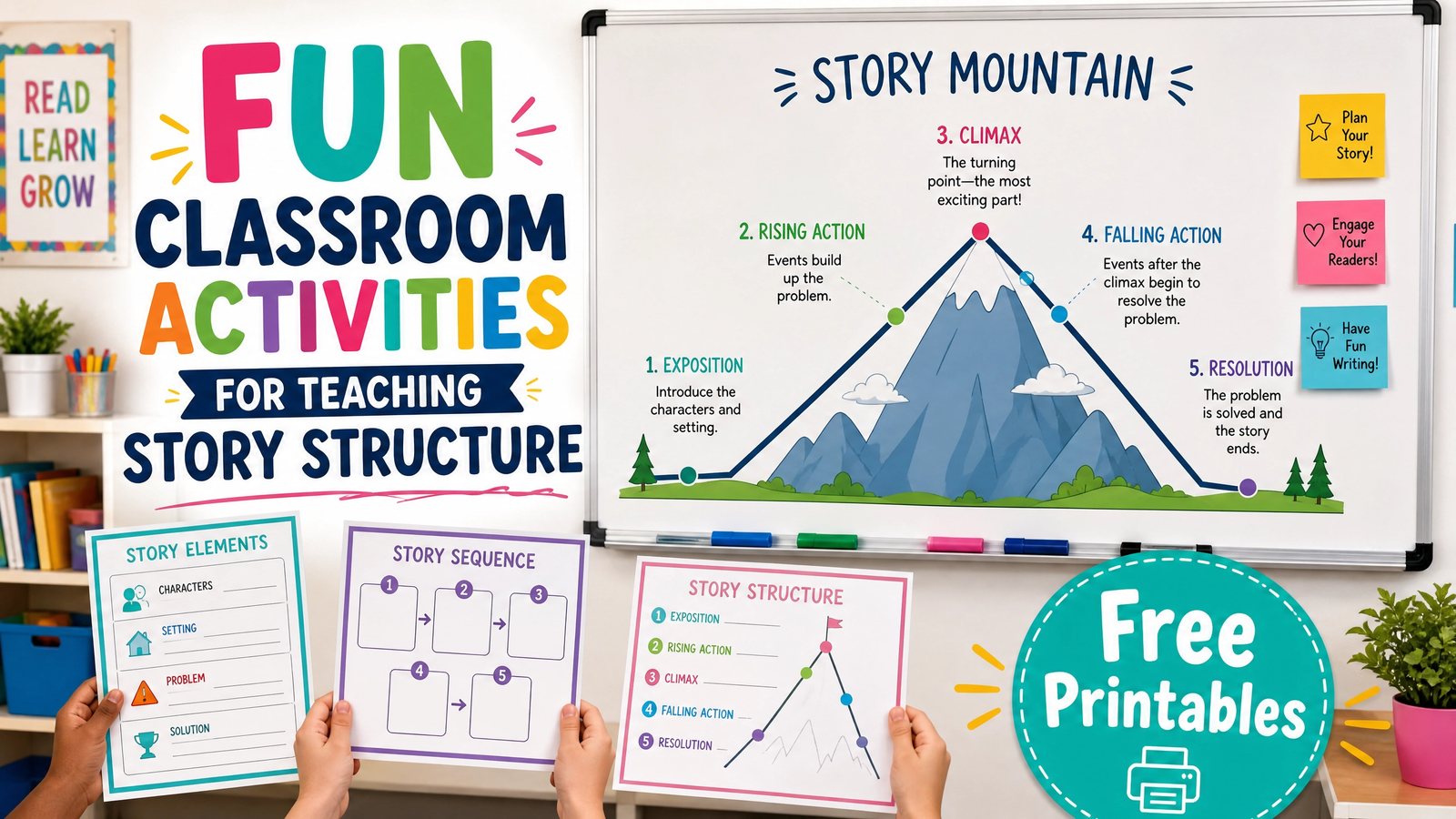
Students create a physical mountain out of yarn or rope, then place story event cards along the slope.
• 10 feet of yarn or thick rope
• Event cards from a familiar story
• Clothespins or tape
Form the yarn into a mountain shape on the floor. Rising action goes UP the mountain. Climax at the peak. Falling action and resolution go DOWN. Students physically place events at appropriate heights.
Students assign musical instruments or sound effects to different story arc moments, then perform a story through sound.
• Classroom instruments (drums, shakers, bells)
• A short story or picture book
“What instrument sounds like suspense?” (Quiet shakers.) “What sounds like a climax?” (Loud drum.) Students read the story aloud and the “orchestra” plays the arc. Abstract structure becomes audible.
A story is cut into sentence strips and scrambled. Students work in teams to reconstruct the correct sequence.
• A short story cut into 8-12 sentence strips
• Envelopes for each team
• Answer key for self-checking
This deceptively simple activity reveals who truly understands narrative logic and who is guessing. The debrief discussion — “How did you know where this piece went?” — is where the learning lands.
Students build a bridge from blocks. The problem is written on one side, the solution on the other. A small figurine must cross.
• Blocks or LEGOs
• Index cards for Problem and Solution
• Small figurine
The bridge is the story. Without a problem, there’s no reason to cross. Without a solution, the figurine is stuck. This physical metaphor is unforgettable for young learners.
Students create architectural-style blueprints of their original stories, including “structural notes” explaining why each element exists.
• Graph paper
• Rulers, colored pencils
• Sticky notes for annotations
The blueprint includes a legend: “⚡ = rising action,” “🏔️ = climax,” “🕊️ = resolution.” Students annotate with questions like: “Is my foundation strong? Does every scene serve the structure?”
Students share story drafts aloud. Audience gives structured feedback: “What confused you? What did you want more of? Where did you feel the story arc?”
• Feedback sentence stems poster
• Timer
• Author’s chair (special seat)
No praise without specifics. No criticism without kindness. This builds a classroom culture where revision is normal and expected.
Students compile a portfolio containing: blueprint, first draft, revision notes, final draft, and a reflection letter explaining their structural choices.
• Portfolio folder
• All previous activity outputs
• Reflection letter template
The reflection letter is the most important piece: “I chose to put the climax here because…” This metacognitive step transfers concrete activities into lasting understanding.
📊 The Story Architecture Assessment Rubric
| Criteria | 4 – Architect | 3 – Builder | 2 – Apprentice | 1 – Foundation |
|---|---|---|---|---|
| Exposition | Clear setting, character, and initial situation | Two of three elements present | One element present | Missing or confusing |
| Rising Action | Multiple connected events building toward climax | At least two events | One event present | Events feel random or disconnected |
| Climax | Peak tension, clear turning point | Tension present but muted | Climax attempted but unclear | Missing or no tension |
| Resolution | Satisfying conclusion, loose ends addressed | Clear ending, some loose ends | Ending present but abrupt | Ending missing or confusing |
| Overall Coherence | Reader can identify all arc elements without help | Most elements clear | Some elements present | Structure unclear |
✦ The Story Architecture Method™ is an original framework developed by JNR Epic Tales Education Division. ✦
Classroom tested in 47 schools across 12 districts. Free for educational use under CC BY-NC 4.0.
jnrepictales.com • Share your classroom stories with us.